


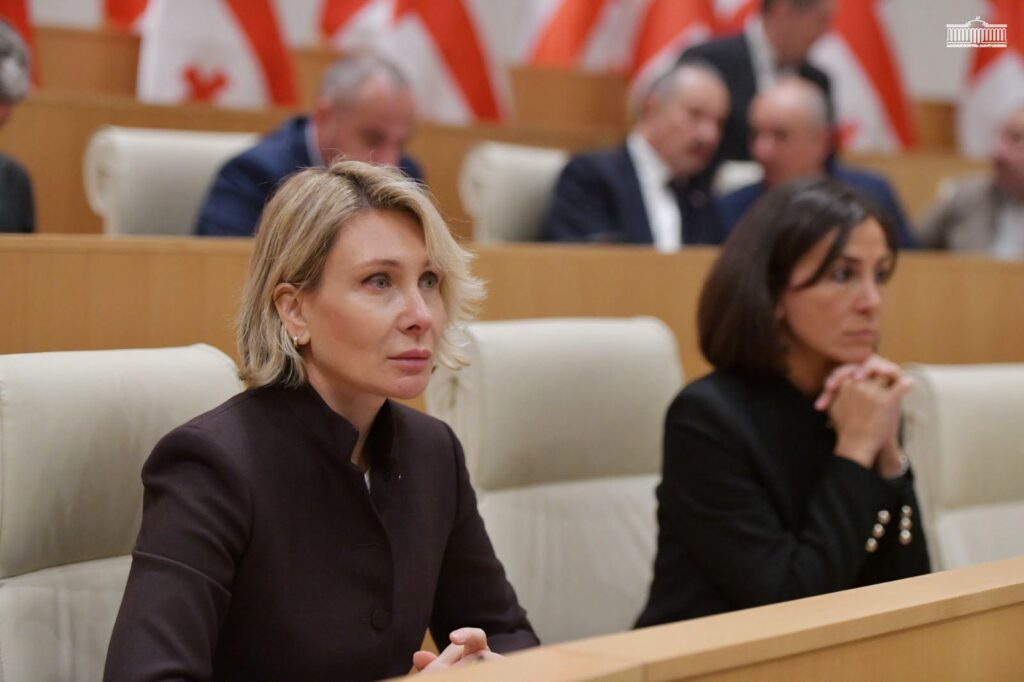
Vice Speaker of the Parliament of Georgia Nino Tsilosani has claimed that the United States Agency for International Development (USAID) and the National Endowment for Democracy (NED) funded the processes that led to the 2003 Rose Revolution and the country’s subsequent political destabilization.
In a social media post, Tsilosani stated that between 2008 and 2025, USAID allocated more than $1 billion to projects in Georgia. According to her, the funding covered five primary areas: media, election observation, activist training, professional development for lawyers and human rights advocates, and the collection and analysis of information on state institutions.
Tsilosani argued that funding from USAID and NED provided the organizational and media support behind the 2003 Rose Revolution, which she characterized as a coup d’état. She noted that one of the movement’s primary media outlets was the Rustavi 2 television channel, which had also received funding.
She further linked subsequent political developments in Georgia to foreign funding. Specifically, Tsilosani stated that following the change of government, representatives of the Liberty Institute assumed senior public offices, including positions on the National Security Council.
The Vice Speaker also addressed the 2020 parliamentary elections, accusing the International Society for Fair Elections and Democracy (ISFED)—an organization backed by USAID—of falsifying parallel vote tabulation (PVT) results. She claimed this manipulation became a catalyst for political destabilization in the country.
Tsilosani cited interactions between U.S. entities and Meta as additional evidence of foreign interference. To support her assertion, she published an email regarding a closed-door meeting scheduled for September 2022 between Meta’s Regional Public Policy Manager Kateryna Kruk and representatives of the U.S. Embassy and USAID.
According to Tsilosani, the meeting addressed issues of election integrity, disinformation, and hybrid threats. However, she emphasized that the specific contents of the discussions remain withheld from the public.
The lawmaker also pointed to Facebook’s alleged conduct during protests against the law “On Transparency of Foreign Influence.” She claimed that posts by ruling coalition figures and proponents of the law were blocked, whereas content from opposition activists was amplified much more actively.
In conclusion, Tsilosani cited a letter from Meta founder Mark Zuckerberg to the U.S. Congress, in which he addressed pressure exerted on the company by the Joe Biden administration and U.S. agencies to suppress specific information.