


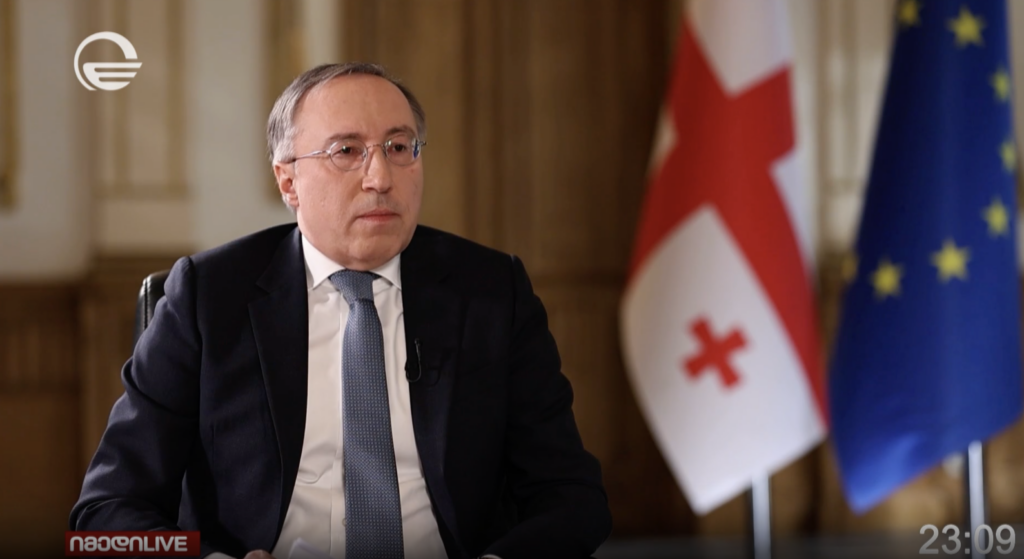
Giorgi Zurabashvili, the Special Envoy of the Prime Minister of Georgia for Relations with the Russian Federation, shared details about the first round of talks with his Russian counterpart, Mikhail Galuzin. Direct dialogue between the two diplomats took place in Minsk on November 19.
Speaking on the pro-government TV channel Imedi, Zurabashvili explained why such a dialogue between Moscow and Tbilisi is necessary. He also dismissed accusations that the ruling party was acting in Russia’s interests, arguing that Moscow’s public praise of Georgian Dream’s policies actually conceals a negative stance toward the government in Tbilisi.
“There are very complex relations between Georgia and Russia that have lasted for decades. These complexities stem from disagreements over Georgia’s sovereignty, its internationally recognized borders, and de-occupation. Twenty percent of Georgia’s territory is occupied by Russia. That is precisely why dialogue and meetings are necessary to address these issues and find ways to resolve them,” Zurabashvili stated.
According to the special envoy, during the meeting with Galuzin, he had expected several issues to be resolved—such as lifting the embargo “on the spot” against a number of Georgian wine producers. “Instead, Mr. Galuzin informed me that [Russia] intends to impose sanctions against two more Georgian wine companies.
“For us, the primary and fundamental issue was returning Georgian wine to the Russian market. As you know, seven companies are under Russian sanctions. I asked Mr. Galuzin what prompted the restrictive measures introduced on October 9. In response, he cited three reasons: complaints about product quality, allegations that these companies are allegedly financing the war on Ukraine’s side, and accusations of spreading anti-Russian narratives.
As for quality, I naturally explained to Mr. Galuzin that Georgian wine enjoys an exceptionally high reputation and is of high quality, while its producers hold numerous international certificates and licenses. Therefore, allegations that Georgian wine is purportedly of poor quality are entirely baseless.
The other two allegations are also completely misplaced and untrue. Nothing of the sort is happening. However, instead of sanctions and restrictions being lifted on the spot, as I had anticipated, Mr. Galuzin told me that two more Georgian wine companies are being considered for sanctions.”
According to Zurabashvili, this news left him with “surprise and bewilderment, since nothing of the kind is happening.” Galuzin, he noted, failed to provide a single fact—neither regarding wine quality nor to substantiate claims of financing the war in Ukraine or anti-Russian propaganda. Thus, these are purely political issues lacking any factual basis, the diplomat remarked.
Overall, according to the prime minister’s special envoy, during the talks in Minsk, the Russian side raised about 10 issues that were directed against Georgian Dream:
“Take, for example, the proposal to twin Don University with one of Georgia’s state universities. On the surface, an entirely innocuous matter. But upon closer inspection and analysis, it becomes evident that all of this is aimed against the Georgian Dream government and fuels false propaganda and narratives alleging that Georgian Dream is pro-Russian. Moreover, all this is done to lend momentum to our opposition forces and bolster them.
Thus, to summarize everything said—be it Georgian wine, regarding whose quality completely incomprehensible claims were raised, accusations of financing the war in Ukraine, anti-Russian narratives, or seemingly harmless humanitarian issues—all of it is directed against the Georgian Dream government, strengthens the opposition, and gives it an added boost.”
In conclusion, Zurabashvili expressed conviction that these issues would not only harm the Georgian government and the Georgian people, but would also damage the population of Russia.
Talks in Minsk
On November 19, the first meeting between Giorgi Zurabashvili, Special Representative of the Prime Minister of Georgia for Relations with Russia, and Mikhail Galuzin, Deputy Foreign Minister of the Russian Federation, took place in Minsk.
According to a statement by the Georgian government, the sides “reached a number of agreements.” The Georgian government did not specify what those agreements were. It was also noted that Zurabashvili and Galuzin discussed trade and economic, as well as cultural and humanitarian relations, alongside the challenges existing in these spheres.
“The need to continue dialogue in order to achieve concrete results was emphasized.”
In addition, the parties discussed the regional security situation.
The Russian Ministry of Foreign Affairs issued a similar statement. Moscow said that Zurabashvili and Galuzin engaged in a “thorough exchange of views on pressing issues of bilateral cooperation, with a focus on trade, economic, cultural, and humanitarian ties.”
“A number of practical agreements were reached. Issues of regional security were discussed,” the Russian Foreign Ministry noted.
Later, the ministry’s official spokesperson, Maria Zakharova, also commented on the meeting. According to her, the parties held an “in-depth exchange of views on key issues of bilateral engagement, primarily in trade, economic, cultural, and humanitarian fields.” Zakharova added that this negotiation format would continue in the interest of further developing cooperation between Moscow and Tbilisi.
Georgian Foreign Minister Maka Bochorishvili, for her part, stated that the negotiation format with Russia is necessary because it addresses matters dictated by “the interests of Georgia and the interests of its citizens”: “These issues require, above all, urgent discussion and direct dialogue.” The minister also added that the Georgian side had no objections regarding the choice of Minsk as the venue for the first meeting of the two countries’ special representatives.
On November 22, Russian Deputy Foreign Minister Mikhail Galuzin announced that Moscow and Tbilisi had agreed to hold direct talks on a regular basis. On November 26, Russian Foreign Minister Sergey Lavrov, while in Minsk, stated that Moscow is interested in restoring normal relations with Tbilisi and views the Georgian side’s attitude favorably.