


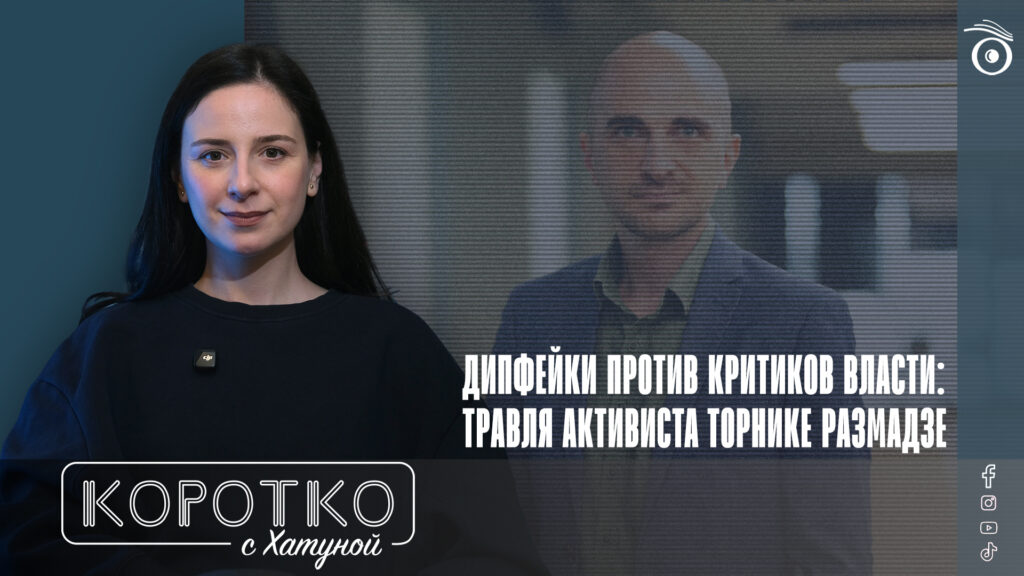
Remember Tornike Razmadze? The activist who was essentially fined for harsh remarks directed at Russian propagandist Margarita Simonyan? Now, a targeted smear campaign has been unleashed against him, deploying deepfakes and fabricated allegations.
In recent days, videos generated using artificial intelligence have circulated widely across social media. The clips feature journalist, activist, and popular blogger Tornike Razmadze, falsely portraying him as a drug dealer.
In one video, a man resembling Razmadze appears to ask a drug dealer for work as a courier. In another, he enters a residential apartment building and leans toward gas meters—an action presented by the publishers as an attempt to hide a drug drop. The captions accompanying the clips were deliberately crafted to create the impression that the journalist was involved in trafficking illicit substances.
According to the Georgian fact-checking platform Myth Detector, two verified videos featuring Razmadze were generated using artificial intelligence. Forensic verification tools estimated the probability of AI generation at 96% for one video and 77% for the other. Fact-checkers also point out that the use of hyper-realistic AI videos to discredit government critics is rapidly emerging as a new instrument of political warfare.
Simultaneously, Razmadze’s personal phone number was leaked on social media, accompanied by insinuations that it could be used to purchase marijuana. Concurrently, pro-government media published reports alleging the journalist was connected to a Facebook page that posted footage of a 2021 residential building collapse in Batumi, falsely presenting it as a recent tragedy.
Razmadze himself views these developments as a continuation of coordinated pressure against him. According to the activist, the harassment is orchestrated by Dimitri Samkharadze, a member of the ruling Georgian Dream party, who has repeatedly made public threats of physical violence against Razmadze.
Notably, a dedicated department monitoring public communication was recently established within Georgia’s Ministry of Internal Affairs (MIA). When justifying its creation, the authorities explicitly stated the objective was to curtail hate speech and abusive campaigns in public spaces. So far, however, the department has focused almost exclusively on critics and opponents of the government. According to the Prime Minister, Razmadze’s case will only be investigated if the Ministry of Internal Affairs deems it necessary.