


Starting April 16, 2026, changes to Georgia’s airspace structure came into effect, establishing a new restricted access zone named “Abastumani-2.” These amendments were introduced by a government decree, partially replacing the airspace organization rules that had been in place since 2018.
The measure involves a ban on passenger and cargo aircraft crossing a significant portion of the country’s southern air corridor. According to published data, the restricted zone has a diameter of approximately 52 km and covers part of southern Georgia—totaling about 2,000 square kilometers. The restrictions apply from the ground level upward without a set upper limit.
As stated in the government order, the reason for closing the skies is the need to protect conditions for astronomical observations—specifically, to prevent the formation of contrails, which can affect atmospheric transparency. The region is home to Georgia’s largest astrophysical observatory.
The changes affect several international air routes connecting Europe and Asia. Among them are routes M747 and N644, used by dozens of airlines, including Lufthansa, Turkish Airlines, Emirates, and Qatar Airways. As a result, aircraft are forced to either bypass the closed zone or alter their flight altitude and trajectory.
According to reports by Radio Liberty, the Georgian side had been conducting negotiations regarding possible changes with European aviation structures, including Eurocontrol, since at least 2023. The restrictions were factored into route planning in advance and officially communicated to airlines through the “Sakaeronavigatsia” agency (the state-owned air navigation service provider).
At the same time, an investigation by Radio Liberty, citing sources in the aviation industry and government structures, claims that the decision to close the airspace may be linked to more than just scientific objectives. According to the publication’s interlocutors, it could be a “whim of Bidzina Ivanishvili,” whose residence is located in the area.

Ivanishvili and Abastumani
Active work to restore the Abastumani resort began about 10 years ago. The project was framed as part of a state regional development program: the government initiated it, while funding and institutional support were provided by the World Bank under the Third Regional Development Project (RDP III), implemented through the Municipal Development Fund of Georgia. The primary focus was on transforming Abastumani into a tourism cluster—restoring 19th-century historical buildings, updating infrastructure, and creating conditions for private investment.
While the project initially intended to focus on reconstructing existing buildings rather than land buyouts, in practice, it affected dozens of households. Some residents were subject to temporary relocation due to the dilapidated state of their homes, and many buildings were divided among numerous owners, complicating implementation.
Notable details include plans to return facades to their “historical appearance,” which involved a partially rejected demand to remove unauthorized extensions, as well as the direct inclusion of compensation mechanisms (payments, moving costs) as a condition for international funding.
Bidzina Ivanishvili first visited Abastumani in 2018. Later, the billionaire stated that the resort village should become “one of the best centers in the world.” Subsequently, a sharp increase in privatization deals was recorded in Abastumani: according to Transparency International Georgia, more than 95% of all land sold over the decade was transacted after this period, with a significant portion sold without competition and in favor of entities linked to the ruling party and the billionaire himself.
Parallel to this, a key property footprint began to take shape. In February 2019, a company affiliated with Ivanishvili acquired the territory of a former tuberculosis sanatorium along with adjacent plots for 3.54 million lari (GEL). Following this, the facility’s medical function was moved outside the resort: about three kilometers away, the Cartu Foundation built a new pulmonology center, which received over 5 million lari in funding by various estimates, and also financed the reconstruction of an outpatient department.
The next stage involved the development of the hotel and tourism segment. Construction of a large international-level hotel complex—identified in sources as the Autograph Collection or Paragraph Abastumani project—was launched on the site of the former sanatoriums and adjacent plots, with a declared investment volume ranging from 60 million lari to 69 million dollars. This project became the largest private investment in the resort.
Against this backdrop, government spending also increased sharply. According to Transparency International’s estimates, approximately 250 million lari in public procurement has been allocated to Abastumani since August 2018. A significant portion of these contracts went to companies linked to donors of the ruling party, often without competition or following the disqualification of other participants. Certain contractors simultaneously participate in Cartu Foundation projects and state tenders, which, according to TI, indicates a risk of conflict of interest and informal coordination between private and public investments.
Thus, by the early 2020s, the restoration of Abastumani acquired a dual nature. On one hand, the original state-international framework remained, focusing on infrastructure and scientific projects—from the restoration of historical houses to the modernization of the observatory. On the other hand, a private investment cluster linked to Ivanishvili emerged, encompassing land, medical facilities, and a major hotel business.

The Abastumani Observatory
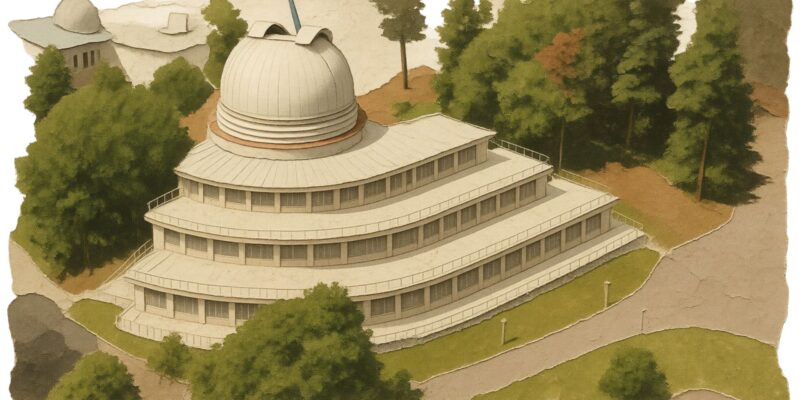
The Abastumani Astrophysical Observatory occupies a special place in this configuration. Unlike the hotel projects, medical facilities, and land deals, its rehabilitation was initially framed as a separate state-scientific process. The modernization of the observatory was implemented under the same regional development program with support from the World Bank and government agencies.
However, in 2019, the Georgian government decided to remove the observatory from the structure of Ilia State University and place it under the management of the Ministry of Education. At the time, media reported that the staff—more than 50 scientific workers—learned about the change in management after the fact.
The opposition and critical media linked the transfer of the observatory to the cabinet with Bidzina Ivanishvili’s interests in Abastumani, pointing out that such a move simplifies control over the territory around Mount Kanobili—a zone with a unique microclimate where the observatory is located and near which the billionaire’s land plot was already situated at the time.
During the same period, as it became known later, the government introduced restrictions on the use of airspace over Abastumani. Authorities stated that the initiative to temporarily “make a small adjustment to air routes” within an eight-kilometer radius came from the observatory itself.
“The main thing for us is the development of this unique scientific center,” the Minister of Economy said at the time.
New Sky Closure
The Georgian authorities also explain the current introduction of restrictions solely by scientific necessity. The ruling party rejects any political interpretations of the situation.
The Mayor of Tbilisi and General Secretary of the “Georgian Dream” party, Kakha Kaladze, stated that scientists had approached the government with a request to “fix the situation”:
“During the observation process, aircraft emissions were creating a problem.”
According to Kaladze, adjusting flight routes is a technical solution and carries no negative consequences. He called the critics’ opposition politically motivated:
“Abastumani was in ruins, and one man, Bidzina Ivanishvili, restored and developed it with his personal funds. Why do you want to find faults in everything?”
Deputy Minister of Economy Tamar Ioseliani also stated that the introduction of the restricted access zone in the sky is aimed at protecting conditions for astronomical observations:
“The changes serve the goals of the scientific observatory, aimed at minimizing the likelihood of contrail formation and protecting the quality of astronomical observations.”
According to her, such restrictions are “widely used international practice” and will not affect aviation flows or economic indicators.
Speaker of Parliament Shalva Papuashvili, in turn, stated that it is the critics of the authorities—the “radical opposition and its external henchmen”—who are trying to “inflict economic damage on the country.”
“This is a continuation of a policy aimed at preventing the implementation of successful projects… The Abastumani Observatory is an important site of interest for everyone visiting Georgia.”