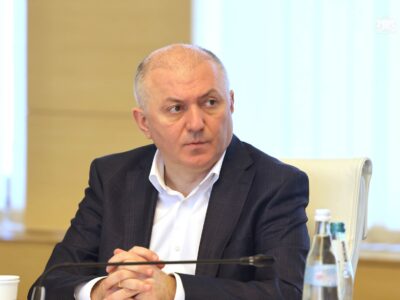

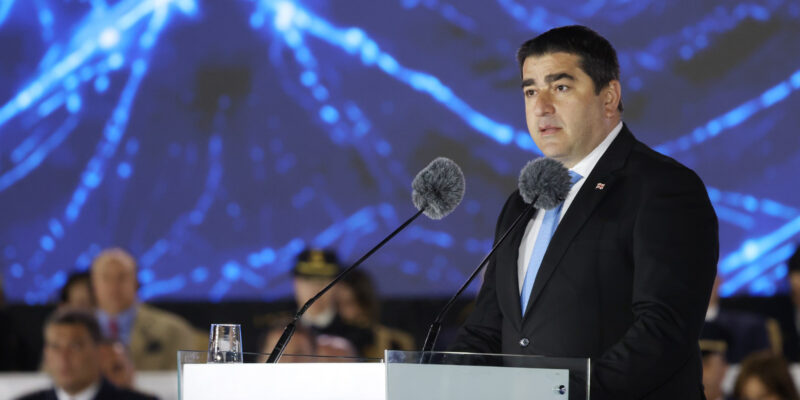

Georgian Parliament Speaker Shalva Papuashvili has commented on a statement by EU Commissioner for Enlargement Marta Kos, who suggested that the right of veto could be restricted for new EU member states.
He stated that the EU’s motto “Unity in diversity” is increasingly being replaced in practice by the principle of “do not deviate from the general line.”
Georgia, Papuashvili emphasized, already has 70 years of experience of nominal and unequal membership in a union (the USSR – Ed.), and the country has no intention of repeating this experience.
“This means that after joining the union, Georgia, like other new member states, will bear the same obligations as other EU countries, but will not possess equal rights with them. In practice, this means that the European Union will be able to make decisions on issues of vital importance to Georgia’s national interests without Georgia’s own participation.
At such a moment, many will likely recall the phrase that Brussels often repeated: “No decisions on Ukraine without Ukraine.” The idea currently being discussed in the European Union effectively means abandoning this approach, not only regarding Ukraine but also all candidate countries. This was also clearly seen by Ukrainians, who stated they would not agree to second-class membership.
<…> This means that you will only be admitted to the club if your voice serves a purely decorative function. Indeed, such an approach will simplify decision-making even further: it will eliminate the need for complex discussions, differing positions, and that part of democracy that presupposes the existence of an alternative opinion,” Papuashvili wrote.
The speaker of parliament noted that the EU has always been based on the principle of equality among all its members, but Brussels’ idea to carry out what he called a “legal segregation of states” radically changes this fundamental principle of the EU, turning it from a union of equal nations into a union of “first-class” and “second-class” states.
“Therefore, it should be said clearly right now: if this idea is implemented, it will no longer be the union that Georgia applied to join four years ago, nor the union that the aspiration to join is enshrined in Article 78 of the Constitution of Georgia.
Georgia already has 70 years of experience of nominal and unequal membership in a union, and we have no intention of repeating it. If EU member states that emerged from the post-Soviet space allow such changes, it will turn out that their problem was not with the Soviet Union as such, but only with who dominated in such an association,” wrote Papuashvili.