

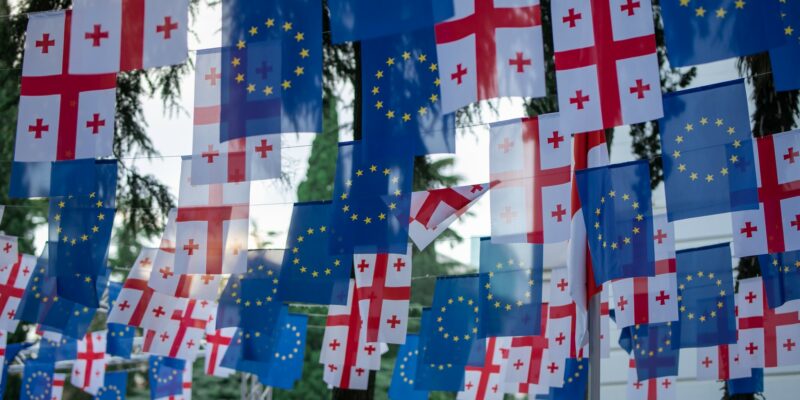

According to the results of the 2026 annual public opinion survey conducted under the EU NEIGHBOURS EAST programme, the majority of surveyed Georgian citizens – 71% – continue to support the country’s accession to the European Union, while an even larger share of respondents – 79% – believe that EU membership will bring more benefits than harm.
The survey results were released by the Delegation of the European Union to Georgia. The poll was conducted in January–February 2026 across the country through face-to-face interviews with over 1,000 respondents.
According to the study, the EU remains the most trusted international partner for Georgian citizens, with 67% of respondents trusting it. However, the number of those who consider relations between Georgia and the EU to be good has decreased: while in 2025, 63% of respondents held this view, in 2026, this figure dropped to 60%.
Despite the high level of support for European integration, 49% of those polled believe that Georgia is moving in the wrong direction towards EU membership. At the same time, 56% of respondents are confident that recently adopted laws concerning civil society and the media will negatively affect the EU accession process.
Eighty-seven percent of survey participants believe that Georgia needs to do more to advance on its path toward European integration. Citizens’ awareness of financial support from the EU remains high at 70%, and nearly half of the respondents (48%) consider this assistance to be effective.
According to the study’s participants, the European Union should play a more significant role in education and lifelong learning (38%), economic development and trade (34%), and healthcare (33%). The positive perception of the benefits of cooperation with the EU also remains high: 76% associate closer ties with the European Union with new opportunities, and 75% believe that membership will strengthen the country’s security.
At the same time, some of those surveyed expressed concerns: 43% believe that the EU imposes its values, while 51% think that the European Union has hidden interests. The study also showed a decline in citizens’ awareness of EU activities. Only 40% of respondents stated that they had recently received information about the European Union, which is 14 percentage points lower compared to 2025.
In addition, 86% of survey participants consider disinformation to be a threat to national security.
For reference: the EU NEIGHBOURS EAST programme has been conducting annual public opinion surveys in Georgia and five other Eastern Partnership countries since 2016.