
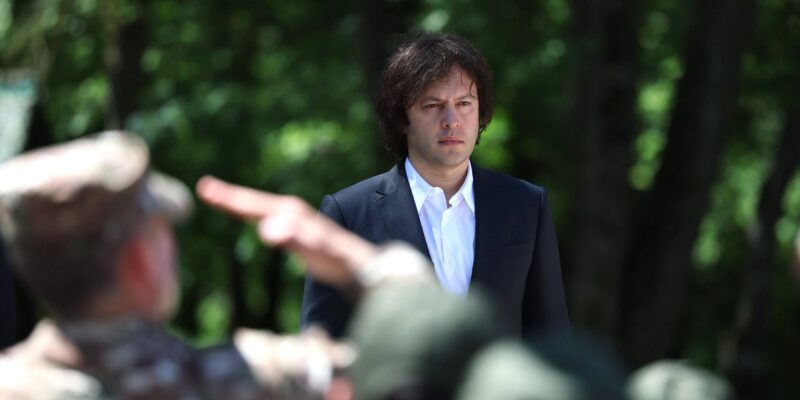

Georgian Prime Minister Irakli Kobakhidze stated that if the European Parliament (EP) wants to organize a revolution in Georgia, “it will receive an appropriate response.”
Commenting also on the law “on grants,” Kobakhidze noted that after its adoption, the situation in Georgia stabilized, as it had previously allowed “radicals” to fund the incitement of hatred and aggression, attacks against the GOC (Georgian Orthodox Church), and attacks on state institutions—serving as a “direct instrument of gross foreign interference.”
He once again recalled five revolution attempts in four years funded by grants.
“When the European Parliament tells us to repeal this law, it means that in the fifth year, they want to organize a sixth attempt at a revolution. Naturally, our reaction to this will be very tough. If the European Parliament wants to stage a revolution in Georgia, it will certainly receive an appropriate response,” Irakli Kobakhidze stated.
The head of government noted that in relations with Brussels, the country’s authorities are maintaining a regime of strategic patience.
“We are in a mode of waiting and strategic patience. As soon as we see that the Soviet approaches in the European Parliament or the European bureaucracy have changed, the dialogue will, of course, be resumed immediately. It depends on them. Therefore, we continue to maintain a mode of waiting and strategic patience,” he stated.
Kobakhidze noted that the EP does not like the laws adopted by the Parliament of Georgia—the law on assemblies and demonstrations was adopted because “150 representatives of ‘Natsdvizhenie’ (United National Movement) caused inconvenience to the whole of Georgia, and that is precisely why we passed this law. Now they do not like it. It follows from this that the European Parliament likes it when 150 ‘Nats’ [members of the National Movement] disturb 3 million 900 thousand people.”
He said the same regarding the law “on sidewalks.”
“The law was adopted because they blocked sidewalks and held rallies there to cause inconvenience to the residents of Tbilisi with a force of just 150 people. This is an absolutely normal and well-balanced law. But the European Parliament does not like it…” Kobakhidze stated.
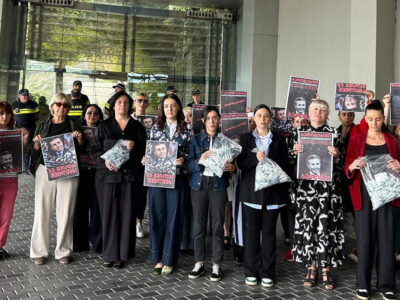
Regarding the injured participants of the pro-European protests, the Prime Minister noted that there had been several instances of violence. According to him, where there were clear signs of a crime, law enforcement agencies had already responded about a month ago.
“<They demand>—saying, release those who used violence. More than 500 people participated in violent acts daily, yet only about 30 people were detained. And even here, they demand a different approach. In reality, these people only want one thing—the weakening of the state and its institutions. Everyone knows perfectly well that they do not care about human rights at all.
Between 2004 and 2012, it was the European Parliament that justified the torture and rape of people both inside and outside of prisons.
They are not interested in human rights at all. The only thing they want today is to return these very ‘Nats’ to power, whom we consider executioners. And, of course, we will respond to such attempts accordingly,” the Prime Minister stated.
According to Kobakhidze, the EP’s task is to review its own Soviet approaches. And if they abandon “Soviet methods,” relations will return to a normal framework.