

This article is part of a partnership with OC Media. You can read the original English version here.
European Commission President Ursula von der Leyen has announced large-scale economic cooperation plans between the European Union, Armenia, and Azerbaijan during her two-day visit to these countries.
During her trip to Baku on Wednesday, von der Leyen announced grants of up to €200 million (about $230 million) for projects in the South Caucasus, as well as the launch of a €20 million (about $21 million) peace support program in Azerbaijan. In Yerevan, she announced plans to grant duty-free access to the EU market for 80% of Armenian exports, in addition to the €52 million (about $59 million) aid package announced back in June.
Von der Leyen’s visit came shortly after Armenia’s parliamentary elections in June, in which Prime Minister Nikol Pashinyan’s Civil Contract party won a majority of seats. One of the key points of its election platform was further integration with the European Union. These elections were widely seen as an important geopolitical milestone, cementing Armenia’s gradual shift away from Russia toward the West.
At the same time, Azerbaijan is also expanding its cooperation with the EU amid its own disagreements with Russia and the European Union’s growing interest in Azerbaijani energy resources, as Brussels seeks to completely phase out its dependence on Russian fossil fuels.
Azerbaijan is a “reliable and proven energy partner of the European Union”
Speaking in Baku on Wednesday alongside Azerbaijani President Ilham Aliyev, Ursula von der Leyen said:
“Today, I have come to deepen our partnership — a partnership that is of great importance to the European Union and is gaining real momentum.”
She began her speech by praising the peace process, thanking Aliyev for his “personal leadership in promoting peace and cooperation throughout the region.” According to her, these efforts “create new opportunities for stability, trust, and shared prosperity.”
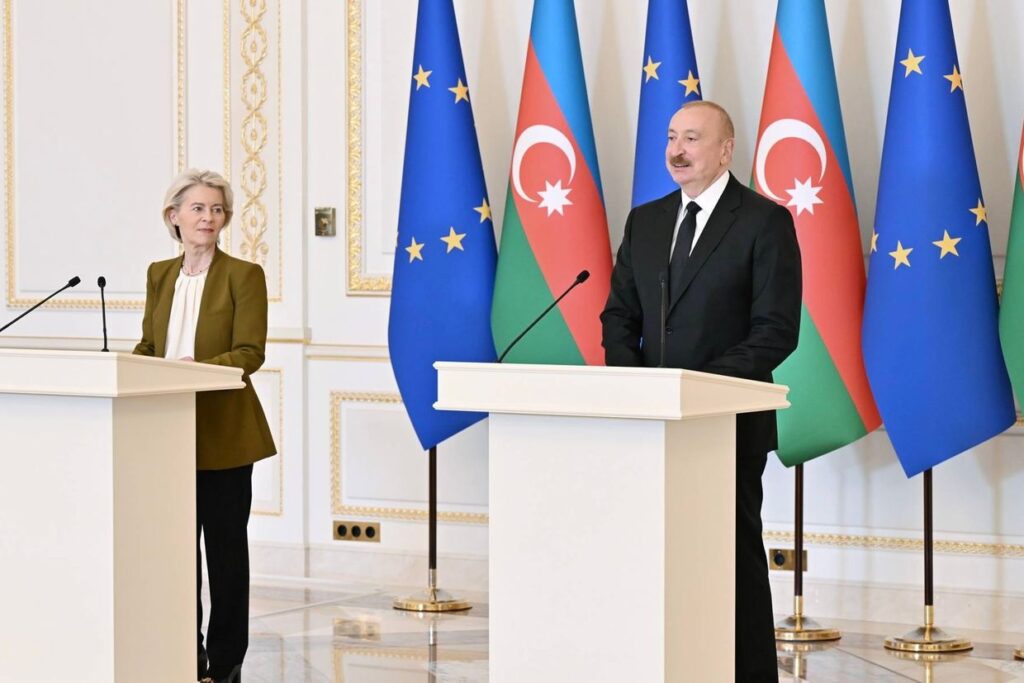
The European Commission chief then announced several new financial assistance and cooperation packages. Specifically, this includes up to €200 million in grants for the development of transport, energy, and digital infrastructure in the South Caucasus. According to von der Leyen, this initiative has the potential to leverage up to €2 billion (about $2.3 billion) in public and private investment.
In addition, the European Union will provide Azerbaijan with €20 million to implement a peace support program. The funds are earmarked for healthcare development, demining, support for rural communities, and other projects that, as von der Leyen noted, should “make the benefits of peace tangible in people’s daily lives.”
The European Commission President also highlighted Azerbaijan’s importance as an energy supplier to Europe, calling energy cooperation “one of the most important pillars of the partnership.” “In recent years, Azerbaijan has proven to be a reliable and proven energy partner of the European Union. We have not forgotten that when Russia used energy as a tool of pressure and cut off gas supplies to Europe, Azerbaijan stepped in to help,” she said.
Although imprisoned Azerbaijani journalists and human rights activists had urged von der Leyen to raise the issue of the country’s human rights situation during her visit, she did not address the topic in her public remarks.
EU offers additional support to Armenia to mitigate impact of Russian sanctions
Ursula von der Leyen arrived in Yerevan, where she met with Armenian Prime Minister Nikol Pashinyan.
At a joint press conference, the European Commission President stated that Armenia is making “impressive progress” toward visa liberalization with the European Union.
“You are moving in the right direction. I know you are working very hard on this,” she said.
In response, Pashinyan expressed hope that Armenia would be able to achieve visa-free travel with the EU by 2029.
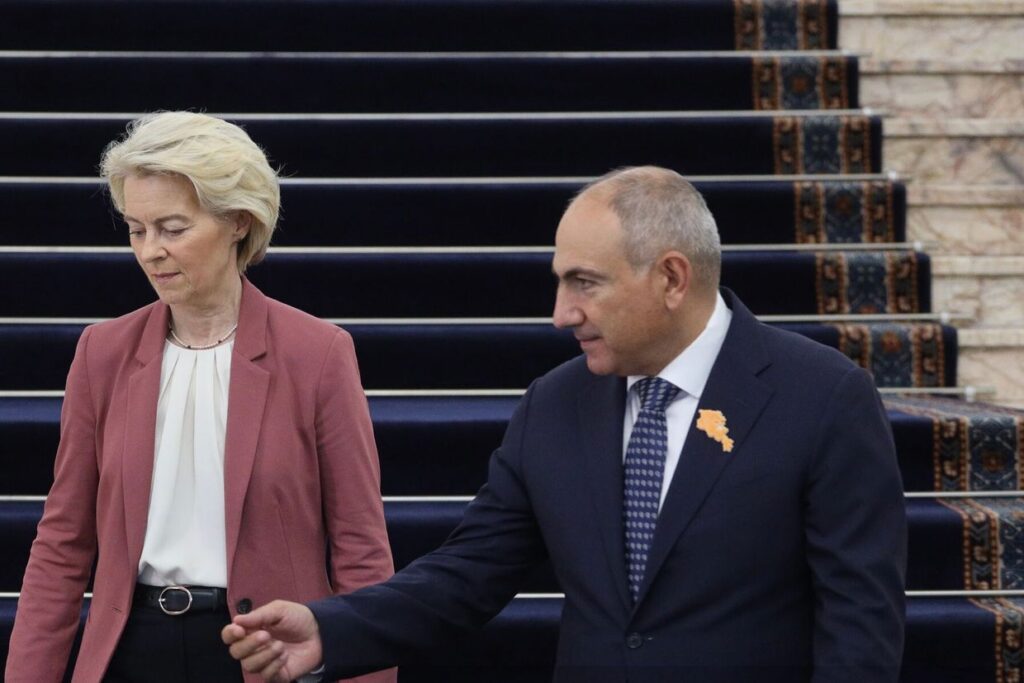
In addition, von der Leyen announced a proposal to grant duty-free access to the EU market for 80% of Armenian exports, complementing the €52 million aid package announced in June.
According to her, the temporary measures will improve the access of Armenian goods to the European market. They cover nearly 99% of exports of fresh fruits, vegetables, and plants previously shipped to Russia, as well as over 91% of beverage and spirits exports.
These measures come amid restrictions imposed by Russia on imports of Armenian products in the run-up to the elections. Many observers viewed these actions as an attempt to pressure Pashinyan’s government and support candidates favored by the Kremlin.
Separately, while in Yerevan, Ursula von der Leyen welcomed the peace process between Armenia and Azerbaijan, as well as efforts to normalize relations between Armenia and Turkey.
“Open borders will transform Armenia’s economic future and anchor its position at one of the world’s most important strategic crossroads,” she said.