

This article is part of a partnership with OC Media. You can read the original English version here.
Trade turnover between Armenia and Russia fell by 20.5% in the first five months of 2026 compared to the same period last year, according to data published by the Statistical Committee of Armenia. The decline occurred against the backdrop of ongoing Russian restrictions on Armenian imports, as well as an apparent significant drop in the re-export of Russian precious metals and stones.
Russia is Armenia’s largest trading partner, and trade turnover between the two countries surged following Russia’s full-scale invasion of Ukraine in 2022.
Trade turnover between the two countries amounted to about $2.2 billion in January–May, down from nearly $2.8 billion in the same period in 2025 — a decline of up to $570 million.
Russia’s share of Armenia’s total trade turnover also fell, from 35.1% to 28%.
Overall, Armenia’s foreign trade remained virtually unchanged. Total trade turnover stood at $7.865 billion in the first five months of 2026, down 0.1% from $7.870 billion a year earlier.
Russian state news agency TASS reported that trade with Armenia had contracted by 21.5%. However, according to figures published by the Statistical Committee of Armenia, trade declined by approximately 20.5%.
The agency also noted that the share of the Russia-led Eurasian Economic Union (EAEU) in Armenia’s total trade turnover fell from 36.7% in January–May 2025 to 29.8% during the same period this year.
These figures emerged after Russia introduced a series of restrictions on Armenian imports and the transit of certain Armenian goods through its territory to other EAEU countries. The measures intensified on the eve of the parliamentary elections in Armenia in June and were widely perceived, both within Armenia and abroad, as an attempt by Moscow to exert economic pressure on Yerevan to influence its policies.
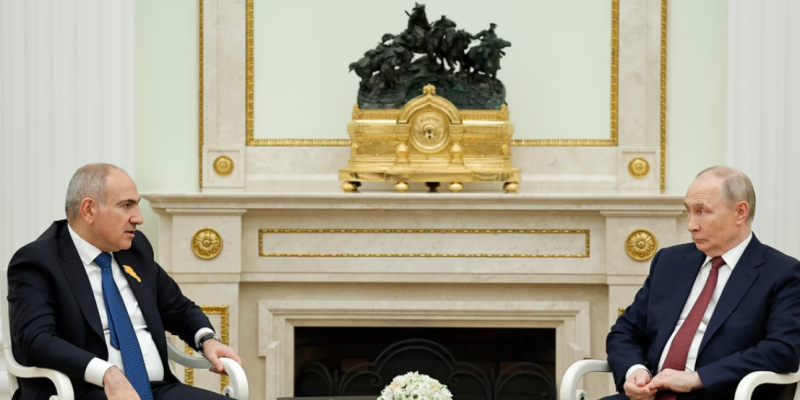
The trade data were published on 6 June, a few days after Prime Minister Nikol Pashinyan traveled to Russia on his first visit since the June elections. Moscow has still not congratulated Pashinyan and his Grazhdansky Dogovor (Civil Contract) party on their election victory, while several Russian officials have questioned the legitimacy of the vote and claimed unprecedented Western interference.
Separately, Russian state media outlet Sputnik, citing first-quarter data from the State Revenue Committee of Armenia, suggested that a significant portion of the decline in trade turnover was linked to a sharp drop in the re-export of precious metals and stones.
Detailed data for individual commodities for the first five months have not yet been published, but according to the State Revenue Committee’s first-quarter data, imports of precious metals and stones fell from $377 million to $136 million, while re-exports of the same goods to the UAE decreased from $346 million to $41 million.
Sputnik argued that, excluding precious metals and stones, imports from Russia had decreased only modestly — by just $12.5 million in the first quarter. The outlet suggested that the collapse of re-exports was the main cause of most of the overall decline in bilateral trade.
Armenia’s exports to Russia did not decrease significantly in the first quarter. However, the data cover the period before Russia introduced restrictions on Armenian exports, so their full impact is not yet reflected in the statistics.
Against the backdrop of dissatisfaction with Yerevan’s decision to move towards European integration in early 2025, Russian officials blamed the decline in trade turnover with Armenia on the warming of Yerevan’s relations with the EU. At the same time, economists already suggested back then that a sharp decline in the re-export of Russian gold from Armenia was the primary cause of the drop.
In 2024, an investigation by The Insider and Hetq revealed that Armenian companies were helping Russia bypass the Western embargo on gold trading.