
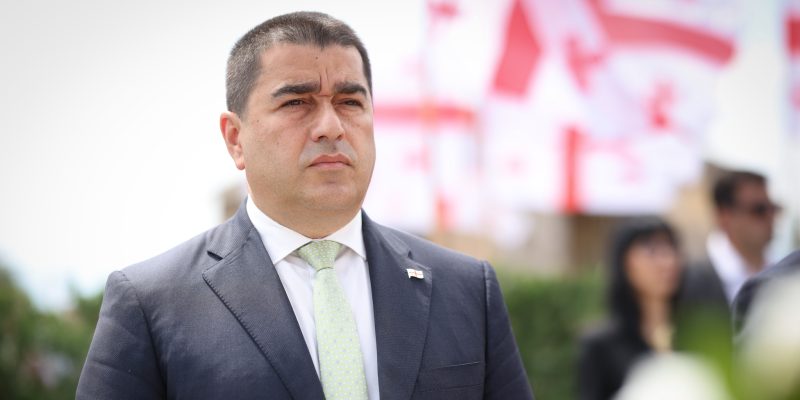

The Speaker of the Parliament of Georgia, Shalva Papuashvili, has stated that EU membership is not an end in itself. This, according to him, applies equally to current EU member states and candidate countries.
Writing on social media, the politician cited Brexit as an example. Papuashvili stated that a question is becoming increasingly relevant: what is the point of joining the EU if its primary advantages and interest-protection mechanisms could be lost even before accession?
The key question, according to him, is not only when Georgia will be able to become an EU member, but also precisely what kind of European Union it is being invited to join, what the rights of a new member will be, and how equal its status will turn out to be.
For most small states, Papuashvili writes, the main guarantee of full-fledged membership in the European Union is the principle of consensus. But if it is abolished and decision-making falls entirely under the control of large states or an EU majority, small countries will be deprived of a crucial tool for protecting their national interests.
“There is a growing impression that large European states intend to effectively establish control over the European Union. This will pose a fundamental threat not only to the political balance in Europe and the EU expansion process, but also to the very values on which the European Union was founded and has developed to this day.
According to the German Foreign Minister, 12 states have already joined the German initiative to abolish the consensus principle in EU decision-making. If this initiative is implemented, the EU will almost inevitably transform from an association of equal members into a union governed by the largest states.
Membership in the European Union is not an end in itself. This applies to both current EU members and candidate countries. Brexit serves as the clearest proof of this.
Joining the EU is a tool that enables a state to protect its national interests more effectively, expand its capabilities, and influence international decisions in ways it could not relying solely on its own size, economic potential, and political resources.
For small states, the principle of consensus remains the primary guarantee of such capabilities. It is precisely what ensures that the voice of smaller countries is not lost amid the interests of large states and the arithmetic of the majority. This mechanism gives a state the right to block a decision that harms its interests and demand that its national position be taken into account.
If the principle of consensus is abolished and decision-making falls entirely into the hands of large states or a stable majority, small countries will lose this fundamental protection mechanism. They will no longer be able to defend their vital interests if those conflict with the political plans of the majority.
In that case, it will no longer be a matter of a voluntary and balanced transfer of part of sovereign powers to achieve broader economic, political, and defense goals, as is the case today. It will be a matter of the almost complete loss of real state sovereignty,” writes Papuashvili.
The Speaker emphasized that a state that can no longer block a decision harmful to it, and upon which obligations can be imposed against its will, will gradually lose not only its freedom of decision-making, but statehood itself.
“From an independent political entity, it will turn into a small region or province within a much larger political system. For large states, such a model might be beneficial, as their size, economic weight, and political influence already provide them with major advantages in decision-making. But for small countries, such changes would be catastrophic.
Therefore, the question becomes increasingly relevant: what is the point of membership if its main benefits and interest-protection tools are taken away even before accession?” asks the head of the Georgian parliament.
Shalva Papuashvili writes that EU membership matters only because it allows a state to support decisions beneficial to itself, promote its own interests, and block decisions capable of harming it. But if this right is taken away, then the EU, according to him, loses its significance as a mechanism for protecting national interests—and the political appeal of membership and its foundational motivation disappear.
“Moreover, under such conditions, it might even be more advantageous for a small state to remain outside the European Union, as it would at least retain the freedom to make decisions independently.
It cannot be ruled out that one of the indirect goals of this discussion is precisely to halt the EU expansion process. It is becoming increasingly clear that no one is considering accepting new members into the European Union as it exists today.
Candidate countries are being offered entry not into the current union as equal participants, but into a pre-altered system where they will be required to fulfill all obligations associated with membership, while their rights and ability to influence decision-making will be significantly restricted.
Therefore, the main question is not just when Georgia will be admitted to the EU. The main question is what kind of European Union the country is being invited to join, what rights it will have, and how equal the status of a new member will be, because membership that deprives a state of its sovereign rights and provides no mechanisms to protect them is no longer integration, but a surrender of sovereignty.
However, it seems Jupiter is permitted even to ‘abduct’ Europa,” writes Papuashvili.