
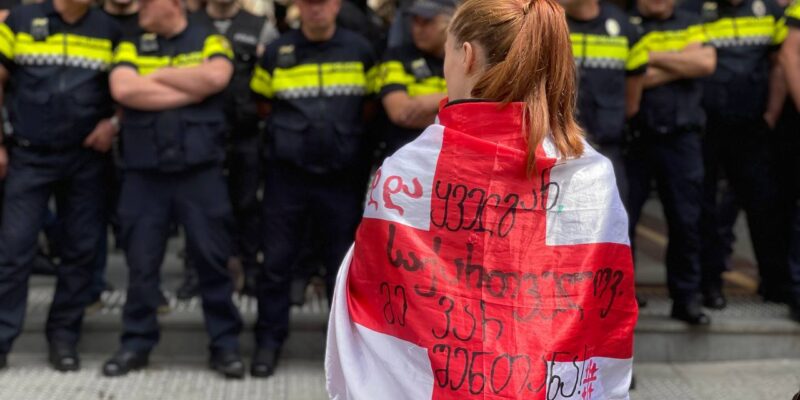

The year 2025 posed a severe test for fundamental human rights and democratic institutions in Georgia. The situation regarding human rights and democracy in the country deteriorated significantly. This is stated in the European Union’s Annual Report on Human Rights and Democracy for 2025.
The EU overview dedicated to Georgia is divided into five chapters. The media outlet Netgazeti published the portion of the report concerning Georgia.
Situation Regarding Human Rights and Democracy
Human rights [in Georgia] were severely restricted by repressive actions and laws violating fundamental rights, including equality and non-discrimination, freedom of expression, assembly, and association, as well as the rights to private and family life, liberty, and security.
In 2025, instances of ill-treatment of protesters by law enforcement agencies were widespread, which in individual cases amounted to torture or inhumane and degrading treatment. Not a single perpetrator was held accountable, fostering a climate of impunity.
Cases of arbitrary detention, excessive use of pre-trial detention, and disproportionately harsh sentencing of protesters and journalists raise serious concerns regarding the right to a fair trial.
Cases were documented of physical assault, sexual harassment, as well as threats of rape or murder by law enforcement officials targeting female demonstrators. New legislation—including amendments to the Law on Broadcasting, the Law on Transparency of Foreign Influence (foreign agents registration), and the legislative package on family values and protection of minors—negatively impacted the right to freedom of expression and the ability of media to operate freely. Widespread incidents of intimidation, threats, verbal and physical abuse, as well as arbitrary detentions of journalists and media workers were reported.
The state of democracy in Georgia was characterized by significant backsliding. Georgian authorities implemented repressive measures against civil society, media representatives, and opposition leaders, severely undermining democratic processes and decision-making, and effectively neutralizing civic participation and the system of checks and balances.
By freezing the bank accounts of several civil society organizations, the authorities used the justice system as a tool of repression and political persecution to strip organizations of critical financial resources and suppress dissent. Civil society and critical voices also faced intimidation, with hostile rhetoric, threats, and violence intensifying. Political pluralism came under threat as the ruling party attempted to ban several opposition parties through the Constitutional Court. Politically motivated persecution of civil society and arrests of opposition leaders contradicted core democratic values.
Georgia ranked 114th in Reporters Without Borders’ 2025 World Press Freedom Index, 52nd in the World Justice Project (WJP) 2025 Rule of Law Index, 56th in Transparency International’s 2025 Corruption Perceptions Index, and scored 34/100 in the CIVICUS Monitor, signaling a repressive environment for civil society.
EU Actions
The European Union consistently called on the Georgian authorities to halt democratic backsliding, repeal repressive legislation, and implement democratic, comprehensive, and sustainable reforms in line with the fundamental principles of European integration and the nine steps defined for candidate status.
The European Union urged the Georgian authorities to respect, protect, and fulfill citizens’ human rights, including the right to a fair trial, freedom of expression and assembly, media freedom and pluralism, and to release arbitrarily detained individuals.
These calls were echoed by the Presidency of the Council of the EU in December 2025, which noted that the steps taken by the Georgian authorities did not meet the European Union’s expectations for a candidate country.
The European Union continued to assess Georgia’s compliance with visa liberalization benchmarks. In December 2025, the Commission determined that Georgia had suffered further backsliding in governance and fundamental rights and continued to breach these criteria. Under the new visa suspension mechanism, the Commission initiated the procedure to suspend visa exemption for Georgian citizens holding diplomatic, service, and official passports.
EU Bilateral Political Engagement
In June, October, and December 2024, the European Council concluded that the actions of the Georgian government had led de facto to the suspension of the accession process. In 2025, political dialogue between the EU and Georgia did not take place due to the Georgian authorities’ continued departure from democratic norms. The European Union continued to downgrade the level of bilateral contacts. The EU–Georgia Human Rights Dialogue has not been held since June 2023.
EU Financial Engagement
As a result of ongoing democratic backsliding, in 2025 the European Union maintained the suspension of financial assistance intended directly for the Georgian authorities. In response to the shrinking civic space and deteriorating human rights situation, €24 million has been allocated to civil society and independent media since October 2024 under bilateral and thematic funding of the NDICI (Neighborhood, Development and International Cooperation Instrument).
Ongoing support focused on targeted assistance to civil society organizations and independent media, access to justice, the rights of persons with disabilities, gender equality and combating gender-based violence, the rights of ethnic and religious minorities, children, LGBTI persons, confidence-building, as well as countering disinformation, foreign interference, and manipulation. The European Union continued its support for the Public Defender’s Office (Ombudsman) to strengthen the ombudsman’s institutional capacity.
Georgian civil society, including human rights defenders, also benefits from expanded support under the regional Eastern Partnership Civil Society Facility, which has been allocated €10 million for 2025–2027, as well as from regional programs supporting human rights, civil society, and independent media.
The EU and Council of Europe Partnership for Good Governance (PGG III) program continued in a reduced capacity, focusing primarily on countering hate speech. Georgia continued to participate in the EU-co-funded project implemented by the European Commission for the Efficiency of Justice (CEPEJ), which supports the modernization of judicial administration in Georgia.
Multilateral Context
Cooperation with the European Court of Human Rights and the execution of its judgments remain inadequate, with 45 cases currently under enhanced supervision by the Committee of Ministers.
The Georgian authorities failed to issue a timely invitation to the election observation mission of the OSCE Office for Democratic Institutions and Human Rights (ODIHR) to ensure comprehensive monitoring of the October 2025 municipal elections.
Furthermore, Georgia addressed none of the key OSCE/ODIHR recommendations following previous elections.
Georgia remained an elected member of the UN Human Rights Council (UNHRC) until the end of 2025. The Human Rights Council’s Special Procedures urged Georgia to investigate instances of excessive police force during demonstrations. Although overall good cooperation was maintained in international forums, Georgia did not align with certain international and EU initiatives.