
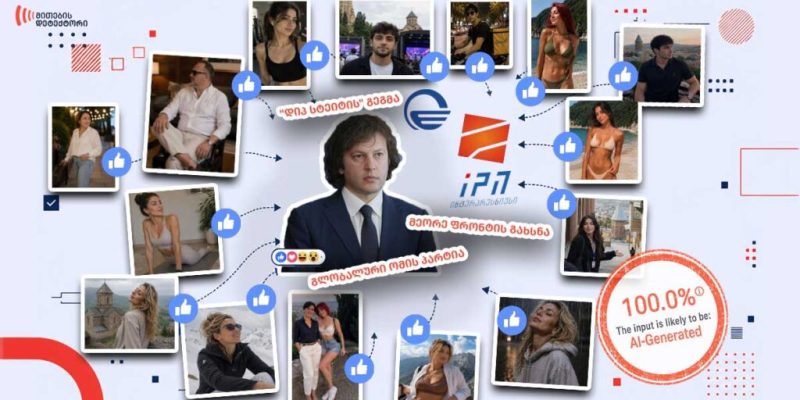

The Georgian fact-checking portal Myth Detector has uncovered 230 fake Facebook accounts that appear to be part of an artificially constructed network supporting the ruling Georgian Dream party. According to the organization’s investigation, the profile pictures on these pages were generated by artificial intelligence, and their activity is primarily focused on promoting specific talking points from the ruling party and its chairman, Irakli Kobakhidze.
The report states that the fraudulent accounts share similar profile pictures, names, and behavioral patterns. A number of the profiles list legitimate workplaces and educational institutions in an apparent effort to boost their credibility.
On August 12, marking the 18th anniversary of the outbreak of the 2008 Russo-Georgian war, Georgian Dream Chairman Irakli Kobakhidze held a press briefing focused primarily on the rise of “Russophobia” in Georgia. According to the monitoring group, Kobakhidze linked the 2008 war to the “Deep State” and cited rallies against Russian tourists and demonstrations opposing the entry of Russian citizens into Georgia as examples of Russophobia.
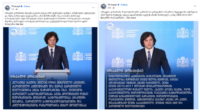
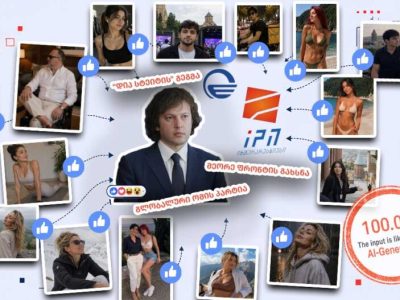
Following the briefing, pro-government television networks Imedi and Rustavi 2, along with the news agency Interpressnews, published infographics (social media cards) on Facebook highlighting the alleged fueling of anti-Russian sentiment in Georgia and the role of the “Deep State” in that process.
Myth Detector analyzed user reactions under these posts and flagged profiles displaying suspicious avatars and identical behavioral patterns. According to researchers, the activity showed clear hallmarks of coordinated inauthentic behavior (CIB), indicating that the pages were operating in unison to artificially inflate support for pro-government narratives.
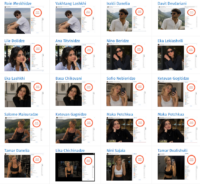
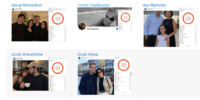
The monitoring operation identified 230 fake accounts sharing characteristics indicative of coordinated inauthentic behavior: AI-generated profile pictures, identical photographs across multiple accounts, and engagement concentrated around the same talking points.
1. Profile photos generated by artificial intelligence (AI):
According to the AI-detection tool Hive Moderation, all 230 avatars have a greater than 90% probability of being generated by neural networks, with several reaching 100%. In addition, characteristic generation artifacts—such as unnatural hand and finger anatomy and other physical distortions—are readily apparent upon visual inspection.
2. Duplication of images and composition:
A number of accounts use identical or nearly identical images, including the same base photographs with minimal variations. Different pages replicate identical framing, poses, and details. In several instances, distinct profiles used identical first and last names.
3. Simulated support through artificial demographic diversity:
The network creates the illusion of broad-based backing across diverse demographic groups: young and elderly individuals, people with conservative or alternative aesthetics, as well as religious, family-oriented, athletic, or leisure-focused personas.
4. Legitimate workplaces and universities listed to build trust:
Most accounts list specific places of employment and education, including municipal utility provider Tbilservice Group, the Tbilisi Transport Company, Georgian insurance firms, commercial banks, microfinance organizations, government ministries, and municipal agencies.
5. Identical behavioral patterns:
A large majority of the pages list their relocation date to various Georgian cities within the window of July 20–24, 2026, although some accounts were created earlier.
6. Activity concentrated around specific political messaging:
Likes and reactions from the flagged accounts are heavily concentrated around conspiracy narratives advanced by the ruling party leadership—such as the “Global War Party,” “Deep State plots,” and opening a “second front”—as well as rhetoric surrounding “Russophobia,” pointing to the artificial fabrication of public consensus.
Myth Detector notes that this is not the first time AI-generated imagery has been deployed in coordinated campaigns. Similar activity was documented in April 2026, when 75 fake accounts posted reactions under Rustavi 2 reports regarding treatments for Duchenne muscular dystrophy. Of those, 47 used modified iterations of the same AI-generated portrait. Several of those profiles had previously participated in targeted smear campaigns.