
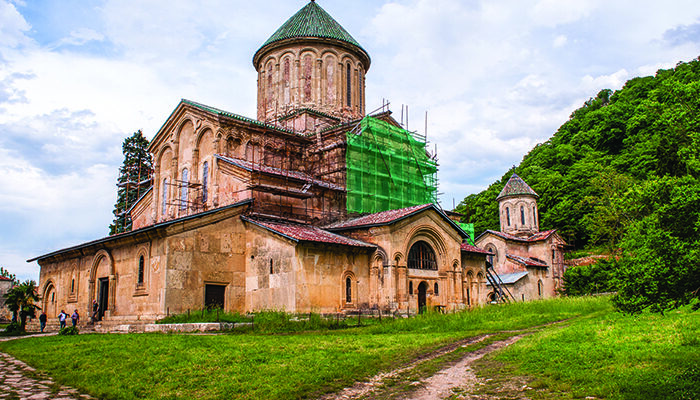

The Temporary Committee for the Rehabilitation of Gelati Monastery has released a statement regarding the progress of conservation efforts. The document addresses a “disinformation campaign” whose authors are attempting to question the advisability of the cathedral’s temporary roof. The committee maintains that the material used is a high-tech coating manufactured in Germany specifically for Gelati.
In addition, the statement notes that claims regarding the alleged mass flaking of the cathedral’s frescoes are groundless: all critical areas have been stabilized, and the scheduled conservation process continues uninterrupted.
The committee urged “a group of several individuals pursuing specific subjective goals and agendas” to refrain from attempts to inflict reputational damage on the conservation work under the Gelati rehabilitation program, to cease deliberately misleading the public, and to “return to the standards of human and professional ethics, as they have repeatedly discredited themselves through lies and slander.”
“In view of high public interest, the Temporary Committee for the Rehabilitation of Gelati considers it necessary to respond to yet another wave of disinformation regarding the ongoing conservation work at Gelati, which has recently circulated on social media and across the media landscape. Unfortunately, there are deliberate attempts by a certain persistent group to mislead the public, damaging the large-scale and unprecedented effort to save the complex. Out of respect for society and to ensure full transparency, we present detailed clarifications regarding the allegations that have been made.
First and foremost, the authors of the disinformation campaign are attempting to call into question the expediency of the cathedral’s temporary roof, spreading disgraceful rumors alleging that the church has been covered with so-called ‘cellophane.’ We remind the public that installing a unified temporary roof over the Cathedral of the Nativity of the Virgin at Gelati has been a direct, clear, and primary requirement of the UNESCO World Heritage Centre (WHC) since 2020. Out of 19 design proposals submitted by Georgian specialists and one proposal by an Italian team, only the structural design developed under the leadership of the Temporary Committee for the Rehabilitation of Gelati—through the joint efforts of Georgian and German specialists—proved practically viable and capable of addressing all of the most complex challenges. Notably, this implemented project earned the highest appraisal from the World Heritage Centre.”
The authors of the statement also note that the study on Gelati was conducted by Italian professor Dario Camuffo, “a recognized pioneer in the scientific discipline of cultural heritage microclimate research, whose textbooks are used to train climatology students at Europe’s leading universities.” “Accordingly, it is entirely unclear why the scientific reasoning in Mr. Camuffo’s report is being portrayed as posing a threat,” the statement reads.
“The reality is that the climatological issue observed at Gelati Cathedral (which has progressed over centuries) is typical of all major cathedrals. Specifically: in spring, as temperatures rise and intense warming begins, the cathedral’s 170-centimeter-thick walls retain their winter chill. As sun-warmed air enters, moisture accumulates and condensation forms on the floor and the walls (up to a height of approximately 70 centimeters).
From a physics perspective, when heat comes into contact with cold, moisture in the air condenses, and sharp temperature contrasts even produce dew droplets. Therefore, as one proven solution, Professor Camuffo proposes mild underfloor heating—from the onset of spring warming until mid-summer—until indoor and outdoor temperatures equalize enough for condensation to stop forming.”
In conclusion, the committee emphasizes that the conservation processes at the Gelati complex are “unprecedented in their scale, scientific depth, and involvement of international experts,” and fully comply with the highest international standards for conservation work.