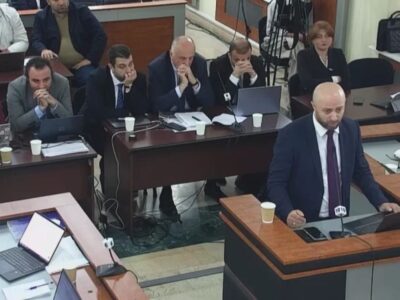



A signing ceremony for the design and construction contract of a new tram line was held at the Tbilisi Sakrebulo (City Assembly).
The document was signed by Giorgi Sharkov, Director General of the Tbilisi Transport Company, and Halit Emre Yılmaz, representative of the EYE consortium (Emre Ray + Yüksel + Erk).
“Today is truly a momentous day. I remember the reaction generated by my initial announcement regarding the tram construction. There was immense enthusiasm, but also a very natural question: when will this vision become a reality? Today, we are answering that question and moving from concept to concrete action,” Tbilisi Mayor Kakha Kaladze stated at the event.
According to Kaladze, the project comprises three phases: conceptual design development, detailed engineering design, and direct construction works. The combined timeline for all three phases is 36 months, with the entire project slated for completion within four years once all accompanying administrative procedures are taken into account.
“Naturally, a single tram line will not resolve all of the capital’s transit challenges, and we make no such claims; however, large-scale transformation always begins with a first step. We want this line to lay the foundation for a modern tram network and mark a new chapter in Tbilisi’s transport system. A challenging work process lies ahead. Projects of this scale inevitably entail certain inconveniences. We will make every effort to minimize disruptions. When a city builds its future, temporary difficulties are unavoidable. What matters most is the lasting outcome once the work is done.”
Kaladze wished success to the Turkish contractor, the Tbilisi Transport Company, and all the specialists engaged in the implementation of the project.
According to the Tbilisi City Hall, the tram line will originate near the junction of the 3rd and 4th micro-districts of Didi Dighomi, traverse Davit Aghmashenebeli Alley and the Dighomi Massive, and terminate at the Didube metro station. The estimated route length will be 7.5 kilometers with 11 stops. The project budget has been approved at 287,654,321 GEL (approximately $110 million).