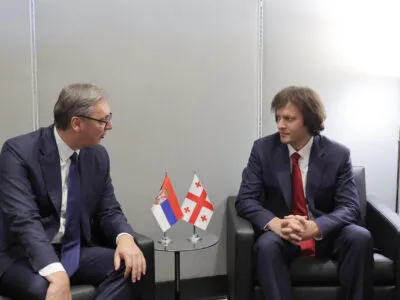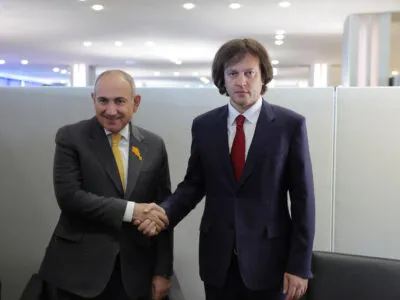

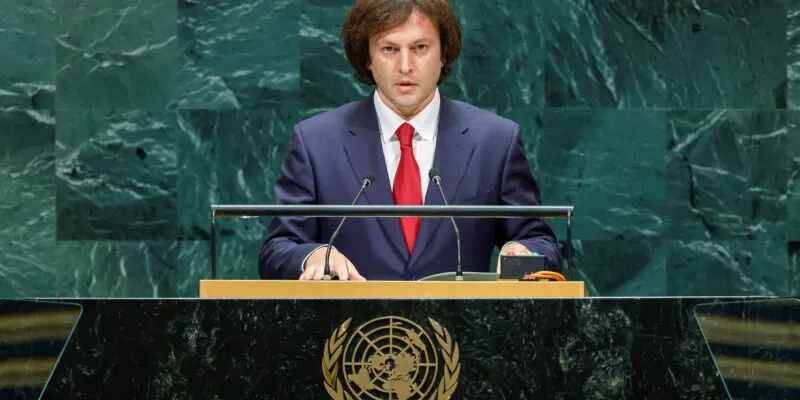

Prime Minister of Georgia Irakli Kobakhidze addressed the 81st session of the UN General Assembly in New York. He addressed the gathering “on behalf of Georgia—a country whose identity has been shaped by centuries of history, resilience, and engagement with a changing world.” The transcript of the address was also published on the official website of the Georgian government.
Kobakhidze identified “preserving peace and strengthening international cooperation” as “foremost priorities” in a context where “events unfolding across various regions of the globe are challenging the status quo and raising questions about the future of the world order.” However, he did not name any specific regions or developments.
According to Irakli Kobakhidze, “achieving lasting peace through the use of force is impossible. It must be built on dialogue, mutual understanding, and mutual respect.”
The Prime Minister noted that Georgia has a particularly acute appreciation for the value of peace, stability, and sovereignty; Georgian statehood has repeatedly undergone severe trials, and “these challenges have only reinforced our resolve to independently choose our own path.”
“Historical experience has also taught us that the price of sovereignty must always be kept firmly in mind, that stability requires protection, and that the endurance of the international order ultimately depends on whether the same principles are applied equally to all states.”
The Prime Minister also pointed to positive indicators in Georgia’s economy, strategic objectives, and infrastructure initiatives, including the construction of the Anaklia deep-sea port. He emphasized that the progress the country seeks is unattainable without expanding cooperation with foreign partners. Kobakhidze also outlined a condition for such engagement:
“Georgia reaffirms its readiness to maintain dialogue with all international partners willing to work with us on the basis of mutual respect and sovereign equality. We are convinced that long-term partnership is forged exclusively through dialogue, and that this outcome will never be achieved through pressure or coercion.”
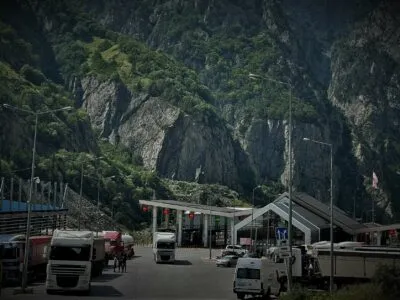
In his address, Kobakhidze recalled that 20% of Georgia’s territory remains occupied by Russia, while hundreds of thousands of the country’s citizens continue to hold internally displaced person status and are unable to return to their homes. He also reached out to “Abkhaz and Ossetian brothers and sisters,” stating that “the dividing lines drawn today will not erase” their shared homeland and common history, “just as they cannot predetermine the future of our children.”
According to the Prime Minister, “the benefits achieved through peace and the economic development of Georgia should not be constrained by artificial dividing lines,” emphasizing that “residents of the occupied historical regions, who have been and will forever remain an integral part of our shared future, must also be able to enjoy the fruits of this development.”
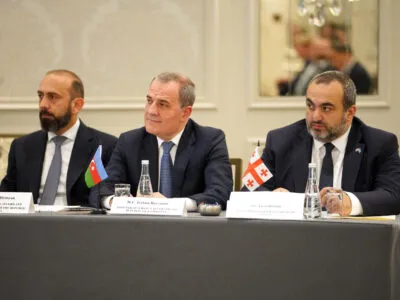
Separately, the head of government pointed out that national stability and prosperity cannot be considered in isolation from the broader regional context. In particular, he stated that the future of the South Caucasus should not be determined by dividing lines drawn in the past.
“We consistently strive to act within regional initiatives as an honest broker, strengthening cooperation and contributing to the pursuit of peaceful solutions. Today, we see a genuine opportunity to start with a clean slate and build a more peaceful and interconnected region, which aligns with our shared aspiration to build a better future. This spirit of cooperation must also translate into tangible economic opportunities for the region.”