
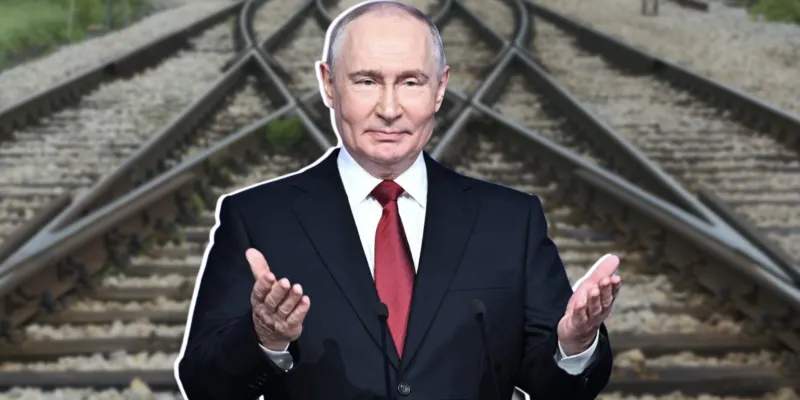

A project for direct rail and road transit linking Russia, Georgia, and Armenia along the Black Sea coast has been presented in Moscow under the working title “Putin’s Path.” This was reported by the publication Vector Kavkaza (formerly the Radio Free Europe/Radio Liberty project Echo of the Caucasus).
The initiative was unveiled by pro-Kremlin research institutions on September 28 at the international conference “Prospects for the Development of Transport and Logistics Networks in the South Caucasus.” The proposal was drafted by Vladislav Gasumyanov, director of Russia’s National Research Institute for the Development of Communications (NIIRK).
The project is reportedly being actively lobbied by several Armenian experts, who frame it as an instrument to “unblock” the region and call for “fresh, non-political solutions” in an attempt to integrate the Russian scheme into the Armenian government’s official “Crossroads of Peace” concept. However, independent Caucasian analysts describe the project strictly as a lever of hybrid political pressure from Moscow.
The conference was a joint initiative of NIIRK, the Center for Russian Studies at Yerevan State University, and the Center for the Study of Russian-Armenian Relations at the Institute of Oriental Studies.
“The political and geopolitical landscape in the South Caucasus has altered significantly, which is why the issue of restoring rail links in the region is returning to the agenda—albeit under fundamentally new conditions,” said Aram Safaryan, director of the Center, during his address at the Moscow forum.
He recalled that discussions regarding the reopening of rail traffic along the Moscow–Tbilisi line via self-proclaimed Abkhazia had begun back in 2016. At that time, however, “the process stalled.”
“‘Putin’s Path’ should not be viewed as an idea competing with other transit initiatives, but rather as an opportunity to integrate it into the broader transport and logistics framework of the South Caucasus,” Safaryan noted.
Tatul Manaseryan, head of the Alternative Research Center, also argued in his report that reopening the railway could drive development across the entire region. He observed that the evolution of Russian-Georgian relations in recent years reflects a shift in Tbilisi’s previous posture. Specifically, Georgian policy is “increasingly viewed through the prism of the country’s national interests, rather than solely through alignment with the West.”
“The prudence of the Georgian political elite will, I believe, allow it to evaluate the situation and, under any political scenario, regard the reopening of this railway as an enabling factor rather than an obstacle,” Manaseryan said.
At the same time, independent Armenian experts emphasize that implementing the project on Russia’s terms is impossible, Vector Kavkaza notes.
Grant Mikaelyan, director of the Armenian Research Institute (ARI), argues that transport corridors in the South Caucasus must be assessed not only through an economic lens, but also from a geopolitical standpoint. While acknowledging that the regional balance of power is shifting, he points out that it is by no means tilting in Russia’s favor. According to the analyst, Turkey is consolidating its influence in the South Caucasus, maintaining substantial sway in Azerbaijan, and expanding strategic partnerships with Georgia, while Moscow’s regional presence is, conversely, diminishing.
Vector Kavkaza notes that Armenia’s railway infrastructure was transferred under a concession agreement to South Caucasus Railway (SCR)—a subsidiary of Russian Railways (RZD)—in February 2008 for a term of 30 years, with an option for a 10-year extension. Until recently, this arrangement was regarded as a guarantee that no major transit initiatives in Armenia could proceed without Russian involvement. The dynamic shifted following the August 2025 signing of the agreement establishing the “Trump Route” (TRIPP). From that point forward, Moscow began seeking its own routes to prevent being permanently sidelined from the unblocking of regional communications in the South Caucasus, the outlet reports.
Tbilisi has not yet issued any official or expert response to “Putin’s Path.” Vector Kavkaza reports that both the Moscow conference and the lobbying statements delivered there by Russian and Armenian experts have so far been entirely disregarded by the Georgian side.
Meanwhile, the Georgian authorities’ baseline stance on restoring transit across the de facto frontier along the Inguri River remains firm and non-negotiable. Tbilisi maintains that it will not enter into any talks or communications with the Russian Federation regarding the Abkhazian railway section until Moscow withdraws its military bases from the occupied territories.
Georgian security analysts emphasize that opening through-traffic in breach of the Law on Occupied Territories—without re-establishing full Georgian customs and border control on the Psou River—is legally impossible. Any attempts to launch rail transit on the Kremlin’s terms are viewed in Tbilisi as a direct threat to national sovereignty, capable of triggering a severe domestic political crisis.
“Consequently, the ‘Putin’s Path’ project currently remains nothing more than a declarative propaganda maneuver by Moscow, completely detached from the region’s international legal realities,” Vector Kavkaza concludes.