


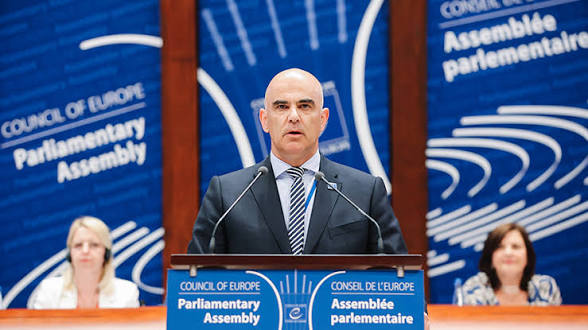
According to Council of Europe Secretary General Alain Berset, the democratic backsliding in Georgia is causing grave concern in Strasbourg, the Publika news outlet reports.
“We are witnessing restrictive legislation, the shrinking of civic space, and pressure on the opposition. All of these factors undermine political pluralism, as well as the commitments undertaken by the country as a member of the Council of Europe,” Berset stated in Strasbourg on October 27.
The CoE Secretary General commented on the ongoing proceedings before the Constitutional Court of Georgia, which is reviewing a lawsuit filed by the ruling Georgian Dream party seeking to ban five opposition parties. According to him, he had already publicly voiced concern over the matter last week, while refraining from offering premature judgments on the outcome of the case.
“We must never forget that our work is rooted in the principle of the rule of law. This means that member states are obliged to adhere to the Convention on Human Rights and the case law of the courts, including the European Court of Human Rights.”
In Berset’s view, proceedings on these matters may continue across judicial instances. He emphasized that he was stating his position with utmost care so as not to call into question the court’s authority or prejudge any judicial ruling. At the same time, he called on Georgia’s parliamentary majority to protect pluralism.
“As we all know, dissolving a political party requires compelling justification, as well as strict adherence to the principles of necessity and proportionality.
Banning parties could entail serious consequences in terms of political pluralism and citizen participation in local democracy.”
Berset also addressed the Council of Europe’s cooperation with the Georgian authorities. He noted that he maintains constant close contact both with the organization’s personnel working in Georgia on the implementation of the action plan and with the Georgian leadership.
“I last discussed the issue of democratic backsliding in Georgia with Prime Minister Irakli Kobakhidze in September in New York, stressing the fundamental importance of fulfilling the country’s commitments.
As everyone knows, the Council of Europe remains actively engaged in this process—including through your work, and the efforts of the Congress and the Parliamentary Assembly.
I would particularly like to highlight the Venice Commission, which very recently presented recommendations concerning the restrictive legislation. The Council of Europe also continues to facilitate the execution of judicial rulings.
I believe it is dialogue that must lead us to tangible progress,” Berset said.
According to him, the Council of Europe continues to engage with Georgia across various formats, including the Congress of Local and Regional Authorities and the organization’s Parliamentary Assembly (PACE). He reiterated the role of the Venice Commission, which delivered expert opinions on the restrictive legislation, and noted ongoing support for the execution of ECHR rulings.
“I believe dialogue must lead us to tangible progress,” Berset reaffirmed.
The Secretary General described the current climate as exceptionally challenging, reminding that Council of Europe membership is not merely a presence within a prestigious international body, but the assumption of profound legal obligations.
“This entails undertaking high-level commitments grounded in the European Convention on Human Rights, as well as participating in ensuring the execution of court judgments. This is a critical point, even though the process takes time. Until then, we can continue working with the country on the basis of dialogue,” he added.
Berset also emphasized the regular meetings held with Georgian representatives in Strasbourg. He recalled that Georgia is one of the organization’s 46 member states, which provides the foundation for constructive engagement.