
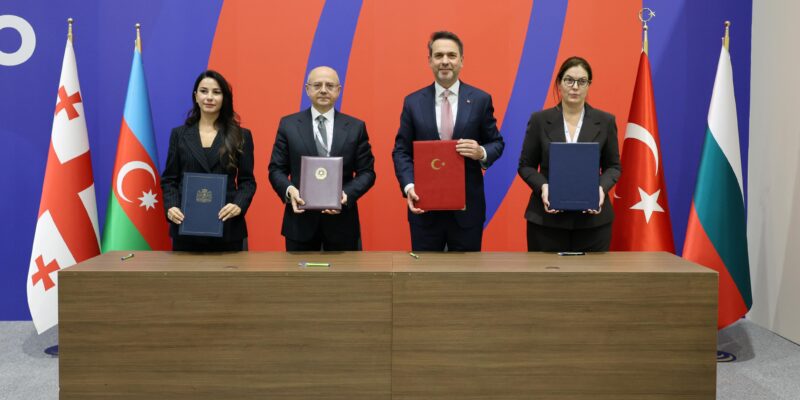

Georgia, Azerbaijan, Turkey, and Bulgaria have signed a strategic partnership agreement in the green energy sector. The project provides for the development of existing power transmission lines between the four countries, the construction of new infrastructure, and the expansion of electricity exports to European markets.
The agreement was signed on November 10 in Antalya, Turkey, on the sidelines of the UN Climate Change Conference (COP31).
The document was signed by:
- Minister of Economy of Georgia Mariam Kvrivishvili,
- Minister of Energy of Azerbaijan Parviz Shahbazov,
- Minister of Energy of Turkey Alparslan Bayraktar,
- Minister of Energy of Bulgaria Iva Petrova.
According to information from the Ministry of Economy of Georgia, under the agreement, the four countries will designate electricity transmission system operators who will become shareholders in a joint venture being established to implement the project.
Under the project, the transmission capacity of the energy corridor is projected to reach 2,000–3,000 megawatts. As the ministry explained, this will enable Georgia to diversify its electricity export destinations and supply green electricity generated in the country to European markets.
“Georgia, Azerbaijan, Turkey, and Bulgaria have agreed to join efforts to further develop the overland power transmission lines between our countries to facilitate even more effective exports of electricity generated in our states to European Union nations with expanded capacity,” stated Mariam Kvrivishvili.
As stated by the Ministry of Energy and Natural Resources of Turkey, the agreement is aimed at strengthening regional energy security, expanding clean energy trade, and diversifying energy sources.
Turkish Energy Minister Alparslan Bayraktar described the project as an “electricity TANAP,” drawing a parallel with the Trans-Anatolian Natural Gas Pipeline, through which Azerbaijani natural gas is supplied to European countries via Georgia and Turkey.
According to Bayraktar, the foundation for cooperation among the four nations was laid in 2024, followed by the signing of a memorandum of understanding in Baku in April 2025, and has now been formalized through an intergovernmental agreement.
In turn, Azerbaijani Energy Minister Parviz Shahbazov characterized the agreement as a crucial step toward establishing a green energy corridor among the four nations.
“This strategic initiative will facilitate the delivery of Azerbaijan’s substantial renewable energy potential to the Turkish and European markets, reinforce regional energy ties, and transform our country into an interregional electricity hub,” Shahbazov stated.
According to information from the Ministry of Energy of Azerbaijan, the ministers of the four countries also met in Istanbul in May 2026. At that time, it was announced that the terms of reference for the project had already been drafted, and the parties agreed to devise an action plan for its implementation.
As clarified by the Ministry of Energy of Bulgaria, alongside the development of cross-border transmission and electricity trade, the agreement provides for the integration of the power grids of the four states.
According to the ministry, the parties are to outline the “necessary technical, commercial, and regulatory conditions to ensure the safe, reliable, and uninterrupted transmission of electricity between the participating countries.”
The Bulgarian ministry also noted that the project entails the development of fiber-optic communications and data transmission.
In parallel with the overland energy corridor connecting the four nations, Georgia is involved in another regional initiative that envisions laying a power cable along the bed of the Black Sea.
This is a separate venture, for which a strategic partnership agreement was signed by Georgia, Azerbaijan, Romania, and Hungary in December 2022.
The project entails the construction of a submarine and overland transmission line spanning approximately 1,155 kilometers, which will connect the power grids of Georgia and Romania. Its planned transmission capacity is 1,300 megawatts.
According to information from JSC Georgian State Electrosystem (GSE), the Italian consulting firm CESI completed the feasibility study for the project and confirmed its technical and economic viability.
In February 2026, Georgian State Electrosystem signed an additional agreement with CESI regarding the preparation and oversight of geophysical and geotechnical surveys of the Black Sea seabed.
Georgia’s state budget has allocated a total of 50 million GEL for the Black Sea submarine cable project for the 2026–2027 period. The financing will be provided by the World Bank.
Much like the Black Sea submarine cable initiative, the agreement signed on November 10 in Antalya is aimed at expanding electricity exports from the South Caucasus to Europe.
Specific timelines for the construction of the new infrastructure and the projected investment volumes under the quadrilateral agreement have not yet been made public.