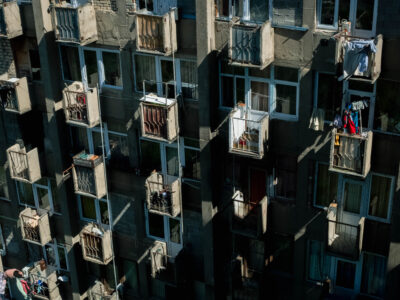

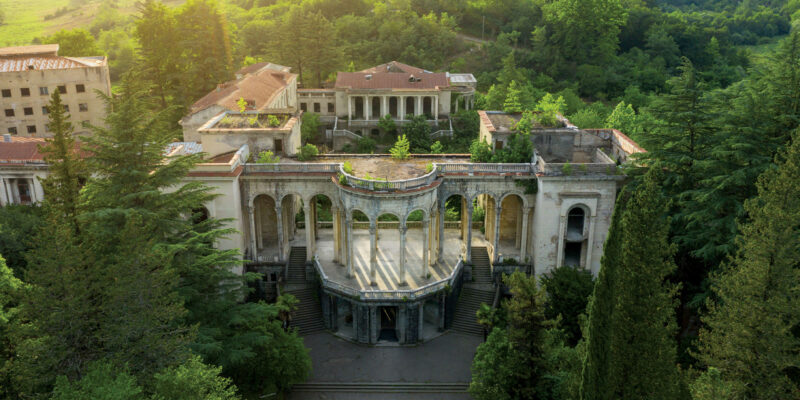

Investors have shown no interest in acquiring ten former sanatoriums in Tskhaltubo. The auctions announced by Georgia’s National Agency of State Property have ended without result.
The combined starting price of the properties stood at 49.2 million GEL (approximately $19 million), with mandatory investment commitments for their development totaling no less than 314 million GEL (around $120 million).
The auctions were announced on October 15 and concluded on November 13. None of the ten lots put up for sale attracted a buyer, according to Georgian media reports.
The assets put on the auction block included the former sanatoriums Megobroba, Medea, Rkinagzeli, Imereti, Intourist, Filiali, Aia, Savane, Gelati, and Geologi.
Starting bids for the individual properties ranged from 2.5 million to 8.8 million GEL. The most expensive listing was the Megobroba sanatorium at 8.8 million GEL, followed by Medea (8.5 million GEL) and Rkinagzeli (6.6 million GEL).
In addition to purchasing the real estate, auction winners were required to commit to investing a total of at least 314 million GEL, excluding VAT, in the development of the sites.
The revival project for the Tskhaltubo resort was first announced in 2019. At the time, Bidzina Ivanishvili, founder and honorary chairman of the ruling Georgian Dream party, declared that he would personally lead its implementation.
The master plan envisaged the acquisition and comprehensive reconstruction of 22 hotels and 9 balneological facilities.
In 2022, the Ministry of Economy launched the “New Life of Tskhaltubo” initiative. The private sector was initially offered 14 former sanatoriums with a total value of around 50 million GEL. While seven properties were successfully sold under the program, three subsequently reverted to state ownership.
At present, four former sanatoriums remain in private hands: Tbilisi, Ushishroeba, Tskhaltubo, and Samgurali. Their privatization generated a combined 16.265 million GEL for the state budget.
In October 2026, Georgian Prime Minister Irakli Kobakhidze, addressing the project’s prospects, stated that the COVID-19 pandemic and de facto sanctions imposed against Ivanishvili had impeded the initiative’s progress. At the same time, he stressed that the state possessed all necessary resources to develop the resort, and that the announced auctions were meant to lay a solid foundation for this effort. According to Kobakhidze, the authorities had been looking forward to their conclusion with interest.
According to Irakli Abesadze, a lawyer and head of the NGO Civic Engagement Center, the absence of bidders reflects weak demand for major investment projects in Georgia. Furthermore, he did not rule out the possibility that the auctions were deliberately derailed to clear the way for selling off state assets at discounted prices later on.
Abesadze suggested that repeat auctions could be held with the starting prices cut by 50% in accordance with state property legislation, with prices potentially being reduced even further in subsequent rounds.