
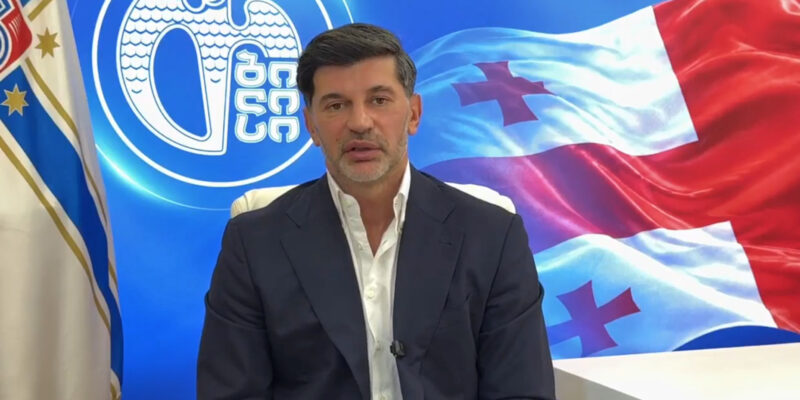

Tbilisi Mayor Kakha Kaladze has responded to a wave of criticism regarding traffic congestion in the capital. In a video address published on his Facebook page, he stated that managing the city’s transport system is the direct responsibility of City Hall, but resolving the issue solely by widening roads and building new overpasses is impossible.
According to him, the daily gridlock on Tbilisi streets is caused by a doubled traffic volume. To substantiate his point, the mayor compared 2017 indicators with current data.
“We often hear criticism suggesting that the existing traffic jams are solely the result of transport changes implemented by Tbilisi City Hall. We are not evading responsibility. Managing the city’s transport system is our direct duty, but we must clearly distinguish between the root causes of the problem and the steps we are taking to address it. <…>
According to Geostat (the National Statistics Office of Georgia), about 474,000 motor vehicles were registered in Tbilisi in 2017, and by the second quarter of 2026, this figure reaches around 948,000. Over nine years, the number of vehicles registered in the capital has doubled,” Kaladze stated.
He added that the difficult road situation is driven not only by a high concentration of private vehicles, but also by Tbilisi’s geographic terrain and the capital’s commercial role: Tbilisi serves as the country’s primary economic and business hub, with residents of other Georgian regions arriving daily for work, business, and various services, while a substantial share of the vehicle fleet is utilized in taxi services and other commercial operations.
“We are not prohibiting anyone from traveling by private car; however, a simple truth must be understood: urban street space is not limitless.”
Speaking about strategic solutions, Kaladze noted that widening arterial roads and constructing overpasses yields only short-term results, as expanding road capacity attracts additional traffic flows under the law of induced demand.
“We cannot widen absolutely every street, demolish buildings, and destroy green spaces merely to accommodate an ever-growing vehicle fleet. This does not mean completely abandoning new road infrastructure. In cases where a specific project forms a critically important transit link and its feasibility is proven by calculations, such decisions must be made. But resolving Tbilisi’s traffic jams solely through junctions and road widenings is impossible,” the mayor stated.
According to him, expanding the public transit network remains the municipal government’s key priority. Since 2017, the city has undergone a 100 percent renewal of its bus and minibus fleet, with 1,059 buses and 1,000 minibuses operating on routes. Negotiations are currently underway with international donors to purchase an additional batch of 200 vehicles.
In parallel, a project is under development to integrate dedicated bus lanes into a continuous citywide network. Modernization of metro station vestibules will continue, and 111 new subway cars will arrive in batches from China, enabling the renewal of 25 operational trains, Kaladze concluded.
In addition, the mayor highlighted plans for a tram line designed to directly link the outlying district of Didi Dighomi with the Didube metro station.