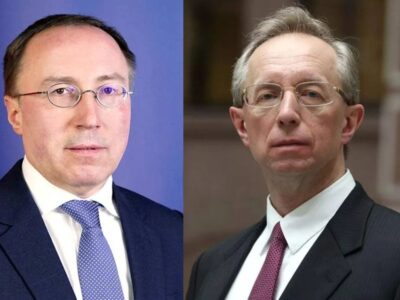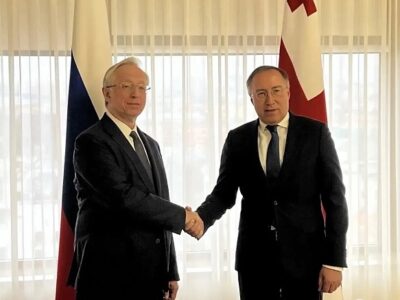



The Georgian side had no objections regarding the choice of Minsk as the venue for the first meeting between the special representatives of Georgia and Russia, Giorgi Zurabashvili and Mikhail Galuzin, the country’s Minister of Foreign Affairs, Maka Botchorishvili, stated on Imedi TV.
Earlier, the authorities faced criticism after direct talks between senior diplomats from Tbilisi and Moscow were held in the Belarusian capital.
“We had no objections to the location in this case, even if it was Minsk. There are certain practical needs: when we speak about the necessity of such a format in general, we are referring to demands dictated precisely by the interests of Georgia and the interests of its citizens. Above all, these issues require urgent discussion and direct dialogue, and that was precisely the purpose of this meeting. In this instance, the venue was not important at all—what was critical was holding the talks in a timely manner and promptly initiating a conversation on matters of significance to us and our fellow citizens.
Overall, in recent years, surrounding our relations and stance on the Russia issue, there has been an attempt, one way or another, to impose on us a fear of dialogue, a fear of negotiations, and their outright rejection. On the other hand, this is the country with which we have the most acute problems, and without dialogue and discussion, resolving or settling any of them is simply impossible.
Therefore, the first thing we must do is overcome the fear of talking. There is nothing dangerous about negotiating with those with whom you have disagreements. It is a necessity. On the contrary, everyone should welcome and embrace the fact that we are bringing contentious issues to the table with the parties with whom these problems exist, and we should not fear such conversations,” Botchorishvili stated.
As a reminder, on November 19, Minsk hosted the first meeting between Giorgi Zurabashvili, the Special Representative of the Prime Minister of Georgia for Relations with Russia, and Mikhail Galuzin, Deputy Minister of Foreign Affairs of the Russian Federation.
According to a statement from the Georgian government, the sides “reached a number of agreements.” The Georgian government did not specify which agreements were reached. It was also noted that Zurabashvili and Galuzin discussed trade, economic, cultural, and humanitarian relations, as well as current challenges in these areas.
“The need to continue dialogue in order to achieve concrete results was emphasized.”
In addition, the sides discussed the regional security situation.
The Russian Foreign Ministry issued a similar statement. Moscow stated that Zurabashvili and Galuzin engaged in an “in-depth exchange of views on topical issues of bilateral engagement, with a focus on trade, economic, cultural, and humanitarian cooperation.”
“A number of practical agreements were reached. Regional security issues were discussed,” the Russian Foreign Ministry noted.
Even before the meeting took place, the Society of Diplomats of Georgia voiced criticism of the talks, stating that “the appointment by the Georgian side of a diplomatic representative for negotiations with Russia and the selection of Minsk as the meeting venue is yet another clear confirmation of a shift in Georgia’s foreign policy course.”
According to the association, which brings together more than 40 former career diplomats, holding negotiations with an occupying power in the capital of an allied state of Russia without the participation of international mediators is not merely a technical or logistical matter.
“This is a political choice that implies conducting negotiations under conditions advantageous to Russia and in a format acceptable to it. Georgian Dream’s dialogue with Russia does not serve the de-occupation of Georgia’s occupied territories, but rather the normalization of relations on Russian terms,” the organization stated.
In the past, Prague had served as the venue for informal dialogue between Tbilisi and Moscow, known as the Abashidze–Karasin format.
Over the past year, the post of Special Representative of the Prime Minister for Relations with Russia had remained vacant. However, on October 21, Irakli Kobakhidze appointed Giorgi Zurabashvili, the serving First Deputy Foreign Minister, to the position, outlining “the peaceful resolution of the conflict with Russia” as one of his new objectives.
According to experts, this signifies an upgrade in status and an expansion of the mandate for Tbilisi’s informal dialogue with Russia: previously, the Prime Minister’s special envoy conducted informal discussions with Moscow on trade, transit links, and humanitarian-cultural ties, while conflict-related issues remained exclusively within the purview of the Geneva International Discussions.