
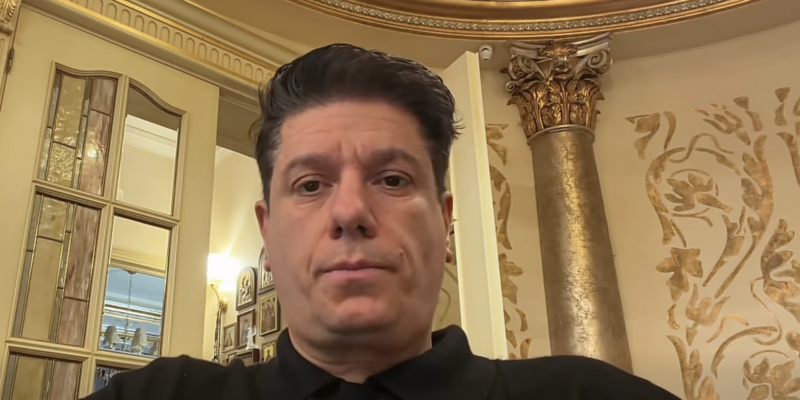

Mamuka Pipia, leader of the pro-Kremlin party Solidarity for Peace, commented on the statement by Giorgi Zurabashvili, the Georgian Prime Minister’s special representative for relations with the Russian Federation, regarding the first round of negotiations in Minsk. In particular, he described the diplomat’s remarks on the pro-government Imedi TV channel as a “demarche.”
In a video address, Pipia noted that Zurabashvili had been warned in advance about upcoming sanctions targeting two additional Georgian winemaking companies. This information was subsequently conveyed during the meeting in the capital of Belarus as well.
“Frankly speaking, I am astonished by yesterday’s statement by Mr. Giorgi Zurabashvili. Why such a demarche was necessary remains unclear. While still in Tbilisi, Mr. Giorgi was informed and cautioned in the most amicable manner that two more companies would face restrictions: Winiveria and Château Mukhrani. The mechanisms and conditions under which these companies could be lifted from the sanctions regime were explained to him,” Pipia stated.
According to him, during the meeting in Minsk, Mikhail Galuzin also outlined those same conditions “in the most friendly manner,” and later commented on the extensive presence of Georgian enterprises in the Russian market.
“Given this, why this was necessary and what purpose this statement serves is personally beyond me.”
As Mamuka Pipia claims, the sanctioned companies are already engaging directly with Russian official agencies to have the restrictions lifted:
“Therefore, it is better to choose one’s words more carefully and cooperate with the Russian side.”
Earlier, commenting on his meeting with Galuzin, Zurabashvili stated that he was “surprised and stunned” by Moscow’s stance regarding sanctions against Georgian wine companies. According to the special envoy, he had anticipated that the restrictions would be lifted on the spot; however, it emerged in Minsk that the Kremlin intended to impose sanctions on two additional wine producers.
As a reminder, in October 2026, 14 years after the embargo on Georgian products was lifted, Russia imposed sanctions on several Georgian producers of wine, mineral water, and carbonated beverages. Non-compliance with sanitary standards was once again cited as the official justification.
The ban affected Nabeghlavi mineral water (Healthy Water company), Coca-Cola, wines from producers Tbilvino, Teliani Veli, and Wine Man, beer from Georgian Bear Company (Zedazeni), as well as brandy and wine from Askaneli Brothers.
Talks in Minsk
On November 19, the first meeting between Giorgi Zurabashvili, the Georgian Prime Minister’s special representative for relations with Russia, and Russian Deputy Foreign Minister Mikhail Galuzin took place in Minsk.
According to a statement by the Georgian government, the sides “reached a number of agreements.” The Georgian government did not specify which ones. It was also noted that Zurabashvili and Galuzin discussed trade, economic, cultural, and humanitarian relations, as well as the existing challenges in these areas.
“The need to continue dialogue in order to achieve tangible results was emphasized.”
In addition, the parties discussed the regional security situation.
The Russian Ministry of Foreign Affairs issued a statement along similar lines. Moscow stated that Zurabashvili and Galuzin held a “thorough exchange of views on topical issues of bilateral engagement, with an emphasis on trade, economic, cultural, and humanitarian cooperation.”
“A number of practical agreements were reached. Regional security issues were discussed,” the Russian MFA noted.
Later, the ministry’s official spokeswoman, Maria Zakharova, also commented on the meeting. According to her, the parties held a “thorough exchange of views on topical issues of bilateral engagement, primarily in the trade, economic, cultural, and humanitarian spheres.” Zakharova added that this negotiation format would continue in the interests of further advancing cooperation between Moscow and Tbilisi.
Georgian Foreign Minister Maka Botchorishvili, for her part, stated that the negotiation format with Russia was necessary because it addressed demands driven by “the interests of Georgia and the interests of its citizens”: “These issues require, first and foremost, urgent discussion and direct dialogue.” The minister also added that the Georgian side had no objections regarding the selection of Minsk as the venue for the first meeting between the two countries’ special envoys.
Botchorishvili later dismissed reports that subsequent rounds of talks could be held in Moscow or Tbilisi. “There is neither a proposal nor a decision, and this is not on the agenda. Therefore, I believe it is wrong to speak about these matters prematurely,” the Foreign Minister said.
On November 22, Russian Deputy Foreign Minister Mikhail Galuzin announced that Moscow and Tbilisi had agreed to hold direct talks on a regular basis. On November 26, Russian Foreign Minister Sergey Lavrov, while in Minsk, stated that Moscow was interested in restoring normal relations with Tbilisi and positively viewed the Georgian side’s disposition.
For his part, Giorgi Zurabashvili, the special envoy of the Georgian Prime Minister, said that, in reality, the talks in the Belarusian capital were far from simple. According to him, Moscow’s outwardly positive assessments of the actions of the ruling Georgian Dream party in fact conceal its negative attitude toward the government in Tbilisi.