
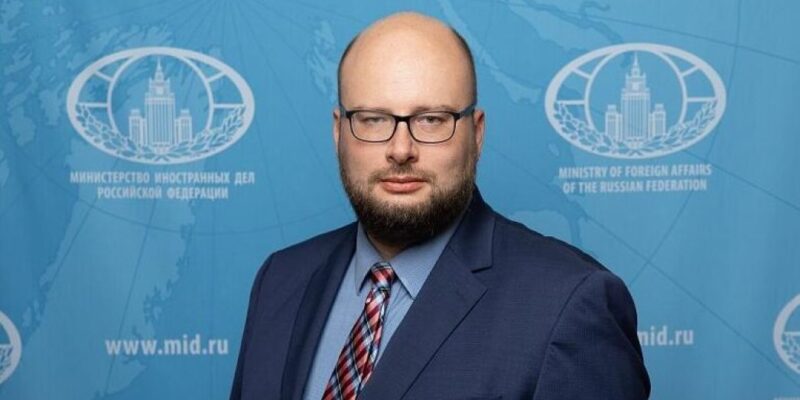

Mikhail Kalugin, Director of the Fourth Department of CIS (Commonwealth of Independent States) Countries at the Ministry of Foreign Affairs of the Russian Federation, stated that the European Union’s policy of isolating Russia has “clashed” with Georgia as well. The Russian diplomat noted that EU pressure on the Georgian authorities and interference in the country’s internal affairs led to a more pragmatic approach in Tbilisi, focused on national interests. Kalugin claims that instead of revising its policy, the EU has intensified its use of political pressure. “Within its policy of isolating Russia, the EU has also clashed with Georgia. Moreover, EU pressure on the Georgian authorities and unceremonious interference in the country’s internal affairs led to a result that Brussels did not expect. […]
Mikhail Kalugin, Director of the Fourth Department of CIS Countries at the Ministry of Foreign Affairs of the Russian Federation, stated that the European Union’s policy of isolating Russia has “clashed” with Georgia as well.
The Russian diplomat noted that EU pressure on the Georgian authorities and interference in the country’s internal affairs led to a more pragmatic approach in Tbilisi, focused on national interests. Kalugin claims that instead of revising its policy, the EU has intensified its use of political pressure.
“Within its policy of isolating Russia, the EU has also clashed with Georgia. Moreover, EU pressure on the Georgian authorities and unceremonious interference in the country’s internal affairs led to a result that Brussels did not expect. A more pronounced pragmatism, based on the national interests of the country and its people, prevailed in Tbilisi. It would seem that the EU should have drawn the appropriate conclusions; however, instead, it began to resort to blackmail and threats even more frequently to force Georgia to change its course,” Kalugin stated.
The diplomat also cited Georgia’s economic indicators, noting that last year GDP growth was 7.5%, and in the first quarter of 2026, it was 9.1%. According to him, the country’s foreign exchange reserves grew by 40%, reaching $6.2 billion.
Among the factors of economic dynamics, the Russian representative named the expansion of trade ties with Russia, noting that trade turnover between the countries in 2025, according to his data, amounted to $2.7 billion.
“Russia remains a key market for many Georgian export goods, as well as the main supplier of strategically important products — energy resources and grain. Every fourth tourist in Georgia is from Russia. Despite Tbilisi’s significant efforts to move closer to the EU, 70% of Georgian exports are still directed to the markets of CIS countries,” he stated.
Kalugin pointed out that Brussels continues to call on Georgia to join the sanctions policy against Russia and limit transport and energy cooperation, including air travel. In his opinion, such measures could have a negative impact on the country’s economy.
“At the same time, Brussels publicly demands that Georgia join the EU’s anti-Russian sanctions, impose an energy embargo against Russia, and cease transport links, including flights.
It is obvious what this would mean for the Georgian economy. However, the EU is essentially not concerned about this. Their main goal is to damage Russia, even if it happens at the expense of Georgia’s interests.
I emphasize that Russia and Georgia are natural partners. We are ready to further develop cooperation with Tbilisi and constructively resolve practical issues.
<…> We expect that the Georgian authorities will continue to be guided by the interests of their people and will not allow the country to be drawn into a confrontation with Russia,” stated the Russian MFA representative.
On the “3+3” Format
The Russian MFA representative stated that the “3+3” regional cooperation format (Azerbaijan, Armenia, Georgia, as well as Russia, Iran, and Turkey) plays an important role in developing cooperation in the South Caucasus and with neighboring countries based on the principle of “regional responsibility.”
He recalled that this is a mechanism in which the coordination of mutually beneficial projects that meet the interests of all participants should occur without external pressure or the imposition of an outside agenda. The main task of the format, according to him, is to prevent dividing lines in the region and to exclude decisions that damage individual countries. Such an approach, Kalugin noted, is the basis for ensuring security, economic development, and sustainable peace in the South Caucasus.
The founding meeting of the “3+3” platform took place in Moscow in December 2021. Azerbaijan and Turkey initiated the creation of the format. Later, in October 2023, the foreign ministers of the participating countries held a joint meeting in Tehran, and in October 2024, at a meeting in Istanbul, an agreement was reached to begin discussing practical areas of cooperation in the fields of transport, energy, and culture.
However, due to a number of objective factors, the Russian diplomat continued, including the Iran-US conflict, the next ministerial meeting was postponed. Despite this, the interest of the participants in continuing the dialogue remains.
“We look forward to the earliest possible resumption of the platform’s full operation. We are currently actively working on launching an expert ‘track’ — a discussion of key and problematic issues in the activities of the ‘3+3’ with the participation of leading political scientists from the participating countries, including Georgia,” Mikhail Kalugin stated.