

“Delays in document processing by Russian customs services at the Verkhny Lars checkpoint are pushing Georgian drivers toward deals with so-called intermediaries and unofficial payments,” states a publication by the Transport Corridor Research Center (TCRC).
According to TCRC, the intentionally sluggish actions of local services at Russian customs are forcing Georgian carriers to enter into financial agreements to expedite drawn-out procedures. Processing documents through a so-called “broker-intermediary” costs drivers 5,000 rubles (approximately 180 GEL).
“According to Umberto de Pretto, Secretary General of the International Road Transport Union (IRU), transport volumes in the region could triple by 2030 due to the growth in trade turnover between countries. However, without improving border crossing procedures between regional states—that is, without reducing administrative barriers—the expected demand for transport could fall 35% short of the projected growth.
According to the IRU Secretary General, in some cases, investments in road infrastructure prove ineffective if trucks are delayed at border points for several days. Research shows that lengthy processing of shipping documents at checkpoints slows down the transport process. When delayed at the border for up to three days, the logistics costs for companies and individual carriers increase by 10–15%. The presence of administrative barriers in road transport affects both the time spent and the financial expenses of drivers.
Amid such barriers in the region, Georgian carriers at the Verkhny Lars checkpoint are forced to engage in financial relations with so-called brokers to expedite document processing for an additional fee, due to the intentionally slowed work of Russian services.
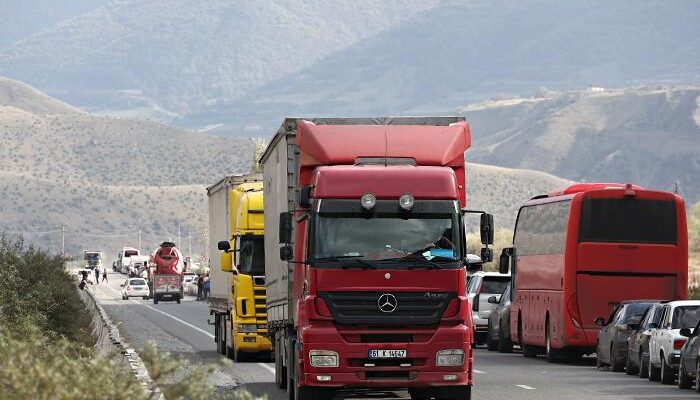
To illustrate the process: a Georgian driver transporting goods from Georgia to Russia, after leaving the waiting zone in Kazbegi, faces a grueling 7–8 hour queue to reach the Russian border post.
After the vehicle and cargo are scanned and a stamp is placed on the CMR (consignment note), the second, more difficult stage—document processing—begins for the exhausted and sleep-deprived driver.
Processing requires the driver to wait another 7–8 hours in a queue behind an iron fence. The sluggish performance of the Russian side pushes the driver to ‘hand over’ documents to a so-called broker and wait for the processing to be completed for 5,000 rubles (180 GEL).
It is evident that the scheme is simple: the broker has a prior arrangement with representatives of the customs services. According to reports, the intermediaries’ ‘rate’ recently increased from 3,000 to 5,000 rubles, sparking a negative reaction from Georgian carriers.
Clearly, while the additional payment for document processing at Russian customs is formally the driver’s choice and depends on their own will, it effectively becomes a forced measure under the conditions of exhausting queues.
We believe that to solve this problem, a method long used in Georgia could be applied: after documents are submitted without hindrance, the driver’s contact information is recorded, and they are called to collect the documents once processing is complete. This method has been used here for a long time and does not require the involvement of intermediaries.
Given that increasing the competitiveness of Georgian carriers and protecting their rights are state priorities, a systemic study of this issue is necessary, along with a resolution in favor of Georgian drivers through existing communication channels with Russia,” the TCRC publication concludes.