
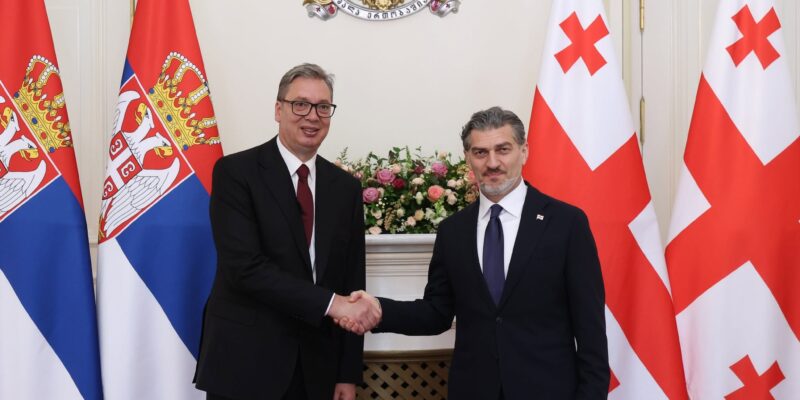

Mikheil Kavelashvili, the sixth president of Georgia, held a meeting with Serbian President Aleksandar Vučić. The parties discussed friendly ties between the two countries, cultural closeness, shared values, and contemporary geopolitical challenges.
Kavelashvili and Vučić discussed deepening cooperation between Georgia and Serbia in the political, economic, technological, educational, and scientific research fields.
The sixth president noted that a shared cultural identity and the complex challenges facing both countries create a solid foundation for the further development of bilateral relations and mutual support of positions on the international stage.
Attention was also paid to intensifying high-level visits. The Administration’s statement noted that Kavelashvili’s visit to Belgrade in December 2025 marked the first-ever visit by a Georgian head of state to Serbia.
Meanwhile, Aleksandar Vučić made his first official visit to Tbilisi, which, as the parties noted, will give a new impetus to the Georgian-Serbian partnership and bilateral dialogue.
“During the meeting, the leaders discussed political processes taking place in the two countries and highlighted the importance of ensuring global peace, security, and stability. It was noted that against the backdrop of a fundamental transformation of the international order and the balance of power, preserving peace and stability in both regions is of particular relevance.
The President of Georgia emphasized that the country, as one of the key links in the Middle Corridor, is interested in expanding its partnership with the Western Balkans region, which will facilitate the development of transport and logistics connections between Europe and Asia,” — the statement from Kavelashvili’s Administration read.
The sixth president reaffirmed the Georgian authorities’ unwavering commitment to peace, stability, and economic prosperity, emphasizing that this is consistent with Georgia’s traditional peacebuilding policy in the South Caucasus, which is aimed at achieving long-term, sustainable stability in the region and strengthening mutual trust between neighboring states.