

This article is part of a partnership with OC Media. You can read the original in English here.
According to a survey by EU Neighbours East, 71% of Georgian citizens support the country’s accession to the European Union, but 49% believe that Georgia is moving in the wrong direction in the European integration process.
According to the survey data, negative perceptions of the EU have intensified in Georgia in recent years. While in 2024, 32% of respondents expressed a negative attitude towards the European Union, this figure rose to 48% in 2025, and reached 50% in 2026.
Meanwhile, the share of positive ratings changed as follows: in 2024, 60% of respondents viewed the EU positively, in 2025 — 43%, and in 2026 — 50%.
Trust in the European Union is also declining. In 2024, 81% of respondents trusted it, whereas in 2025 and 2026, this figure fell to 67%.
Survey participants also noted a deterioration in relations between Georgia and the EU: the rating dropped from 87% in 2024 to 63% in 2025 and 60% in 2026.
Key problems, according to citizens
Among the country’s key problems, respondents identified:
- unemployment — 69%
- poverty — 58%
- low wages and pensions — 57%
Only 11% consider the state of democracy in the country to be the main problem.
Expectations on EU accession
27% of those surveyed believe that Georgia will be able to meet the accession criteria and become an EU member within five years. Another 24% think the process will take between five and 15 years.
34% of respondents named the lack of political will within the country as the main obstacle to membership. Unresolved territorial conflicts and Georgia’s inability to meet accession requirements were each cited by 13%.
Context
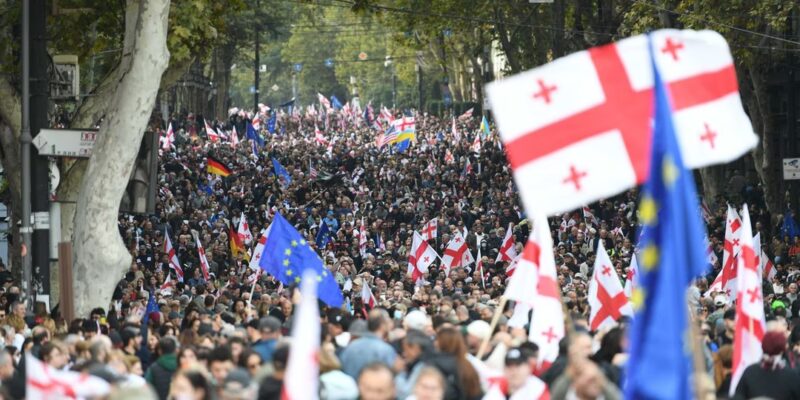
The decline in positive attitudes towards the EU coincided with the Georgian authorities’ decision to temporarily suspend the European integration process in December 2024. This decision triggered mass protests that continue to this day.
Against the backdrop of cooling relations between Tbilisi and Brussels, the Georgian authorities in mid-June appealed to Luxembourg to help facilitate the resumption of dialogue with the European Union.