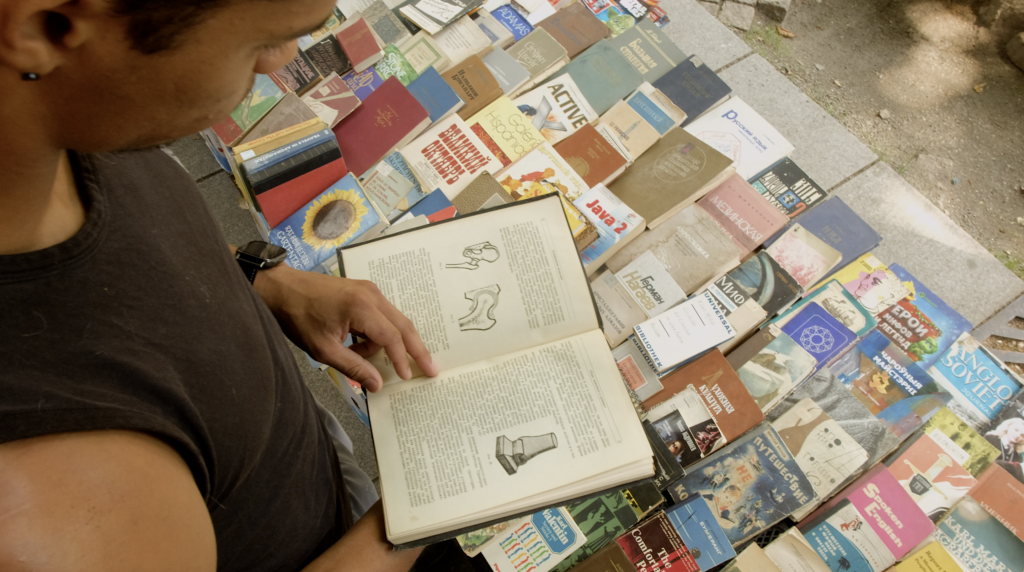


Walking around Tbilisi, one can notice books laid out directly on curbs, building facades, and makeshift stalls. Side by side, you might find Dante’s “The Divine Comedy”, pulp self-help guides like “How to Make Your Husband Rich”, and advanced mathematics textbooks. Yet among these tattered volumes, true bibliographical rarities can be found, hunted by collectors from all over the world.
Street book trading is not a unique phenomenon of Tbilisi’s culture. Similar book stalls can be found in Paris, Istanbul, Buenos Aires, and dozens of other cities worldwide. But in Tbilisi, this tradition has its own roots, tied not so much to a love for antiquarian books as to the severe economic crisis that followed the collapse of the Soviet Union.
Until the early 1990s, the book trade in Georgia was part of a centralized system. In Tbilisi, there were more than 80 bookstores, and the sector itself was controlled by the “Saktsigni” system—a Soviet structure responsible for book distribution in the Georgian SSR. After the collapse of the Union, this system, along with other state and economic institutions, began to crumble.
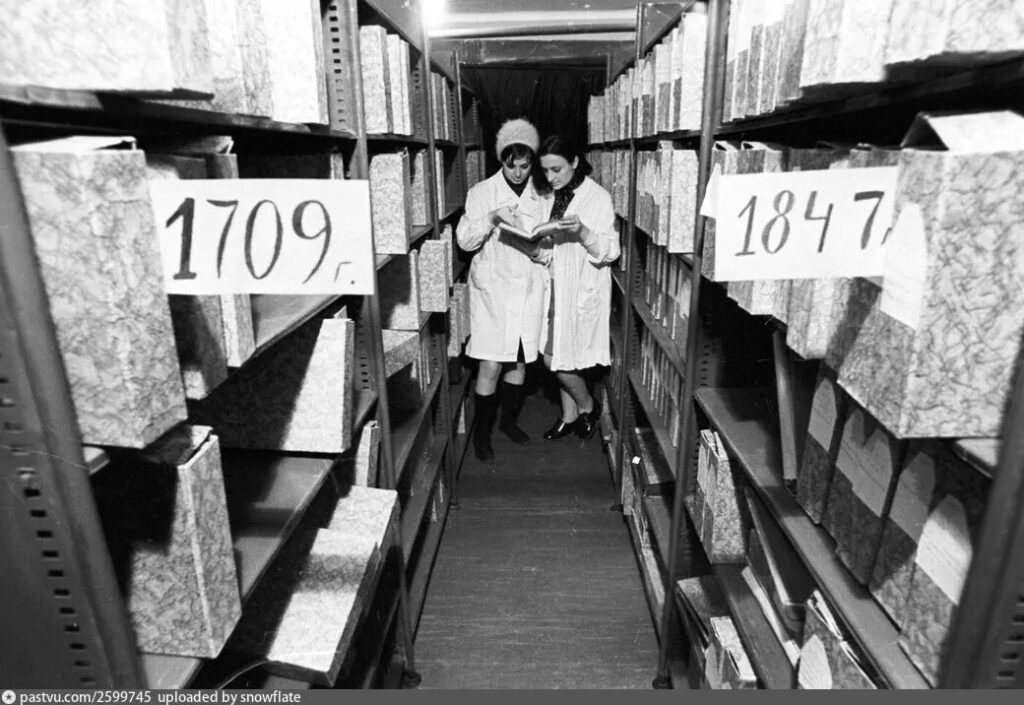
In the early 1990s, against a backdrop of wars, hyperinflation, impoverishment, and shop closures, books began moving onto the streets—sometimes along with those who had spent their entire lives working within the book system. Thus, the sidewalks became home not only to private libraries sold off by struggling families but also to people professionally connected to books: former store managers, book network employees, and antiquarian booksellers.
Subsequently, this group faced not only economic hardships but also the challenges of municipal policy. In 2010, when the Tbilisi City Hall began cracking down on street trading, book stalls were also banned: books disappeared from underpasses, areas near metro stations, public gardens, the space near the “Samshoblo” publishing house, the Youth Palace, and Pushkin Square.
The authorities’ decision was criticized not only by the sellers themselves. Writer Naira Gelashvili said that books on the street are “good in themselves” because they bring life and an “element of culture” to the city.
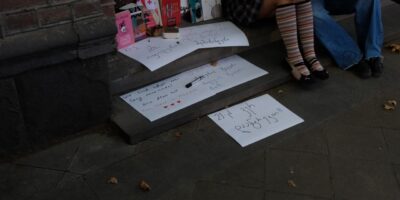
In 2017, when the City Hall launched another campaign against unauthorized street trading, students held a solidarity rally around the booksellers near Tbilisi State University. At the time, city authorities stated that they did not plan to ban trading near the Dry Bridge as part of these measures.
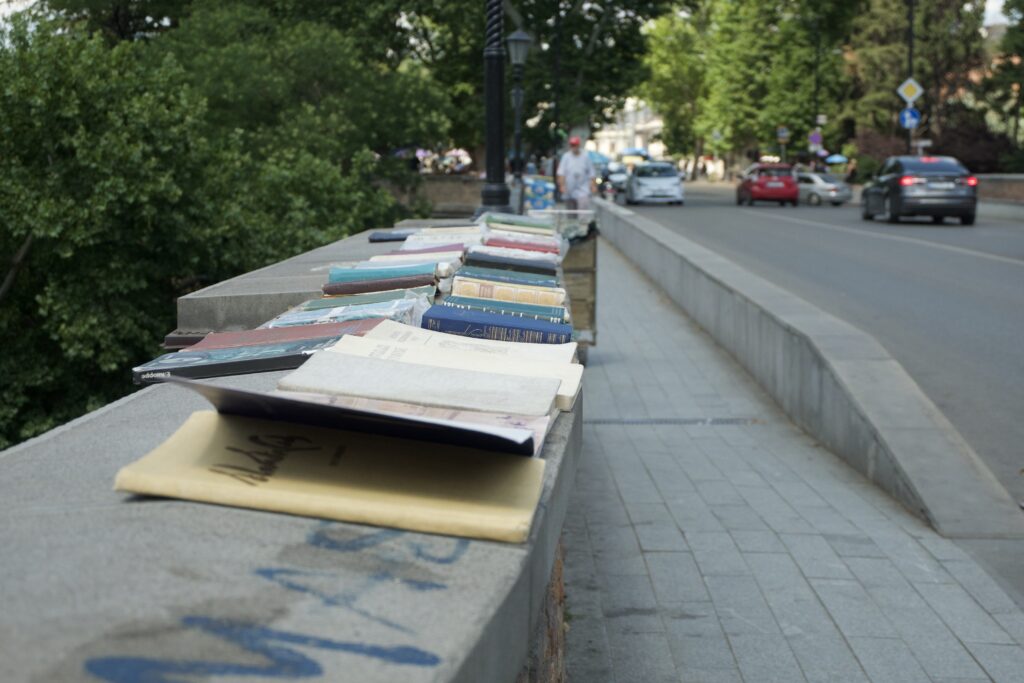
Despite this, the book stalls survived all the bans. Enriko Barsegov is one of Tbilisi’s street booksellers whose stall stands on the capital’s central avenue, Rustaveli. After the collapse of the USSR, Barsegov says, many people stopped reading, left the country, threw away old editions, turned them in as scrap paper, or simply got rid of their home libraries. He calls this period an almost twenty-year “pause in reading”: “After 1990, people abandoned these books,” he recalls.
That is how the books ended up on the street—along with those who were ready to pick them up and sell them again.
“Say someone threw out scrap paper, dumped trash where a book was brought—I took it, laid it out, and I’m selling it. I’m bringing the library back to life, right?”
Picking up one book after another from his stall, Enriko sighs: “In the old days, people studied more.”
Speaking of those who have long been connected with books, Barsegov describes them as professionals of sorts who simply moved from indoors to the sidewalk: “There’s an example—a person has been doing this for 32 years… People have even grown old while selling books…”
For many years, one of Tbilisi’s main book locations has been the Dry Bridge flea market. Today, it hosts dozens of stalls belonging to artists and jewelers, collectors of antique furniture, tableware, medals, vinyl records, and antiques. Sellers of rare and vintage books have integrated into this space as well.
Artur, one of the sellers of rare literature at the market, says that books were not always the main commodity here: “There were only antiques here—gramophones, record players, and so on.” Later, books appeared: from pre-revolutionary editions to mid-20th-century magazines.
Artur’s collection includes pre-revolutionary newspapers, volumes on the Russo-Japanese War, old photographs of Russian tsars, a German satirical magazine from the 1950s, the Polish magazine “Dikobraz” (“Porcupine”), and publications about Nicholas II and the First World War.
Two translations of “The Knight in the Panther’s Skin” also catch the eye. One of them, from 1941, was published “a month before the war.” Artur highlights not only its text but also its design: a book where literature, history, and the work of artists converge.
Regarding how the books ended up on the street, Artur says: “People kept everything—books, newspapers, even matches. How did it all end up on the street later? They passed away, their children didn’t need any of it, many threw everything in the trash, sold it for scrap, but some hid it. Smart people hide things.”
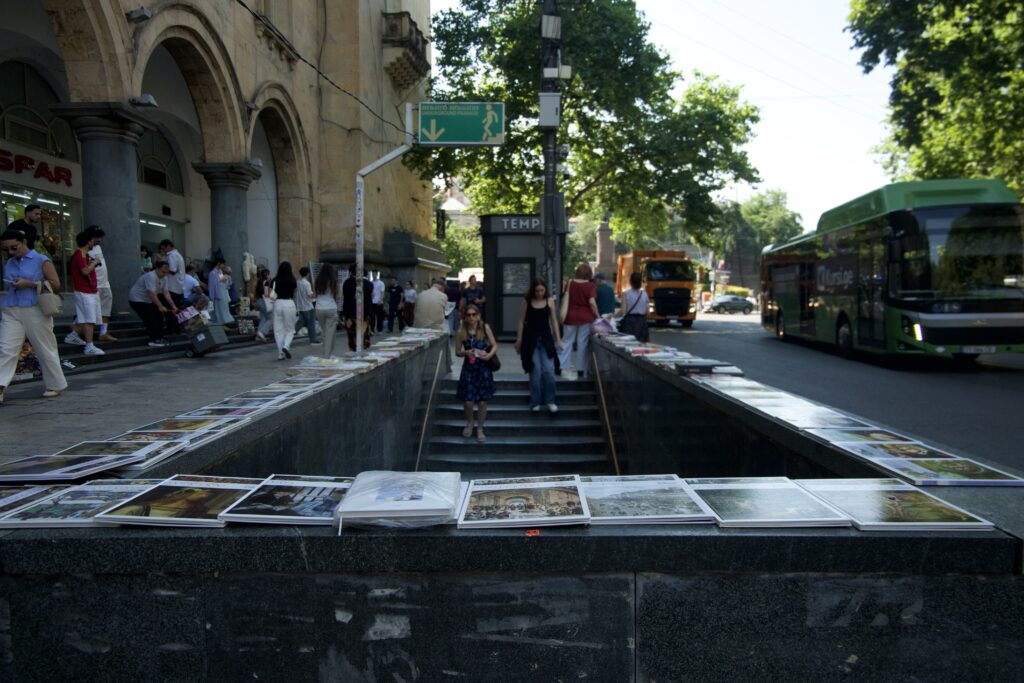
According to Artur, the buyer of such unusual literature today can be anyone. He recalls how a 1917 issue of the newspaper “Invalid” (“The Veteran”) about the overthrow of Nicholas II was bought by an American woman, even though many Russian-speaking buyers did not even notice it. “It depends on the person, what kind of enthusiast they are.”
Tamar from Bookvica, a Tbilisi rare book shop on Uznadze Street, agrees that predicting the buyer is almost impossible. They work with early printed books, Soviet samizdat, rare editions from the avant-garde and constructivism eras, children’s and scientific literature, autographs, and manuscripts. The shop is an official member of the International League of Antiquarian Booksellers (ILAB), founded in 1947.
According to Tamar, books often reach street vendors and antiquarian booksellers after apartment renovations, moves, and clean-outs: in old Tbilisi houses, people simply cannot preserve everything that has stood on the shelves for years. Consequently, family libraries are given away, sold off, or taken out to the street.
Rare copies do indeed turn up at these street markets, Tamar notes. “Everyone has their own pearl,” she says. For one person, a pre-revolutionary volume is a rarity; for another, it’s a children’s book that survived the war.
Even a car repair manual can turn out to be rare. It might not look like an expensive antique, but it has its own biography: while someone was assembling or repairing a car using this guide, oil might have spilled onto the pages, and the book was passed from hand to hand, from workshop to workshop. Here, the value lies not in the print run or the year of publication, but in its own unique history.
Speaking of the most unusual finds, Tamar points to a lithographic portrait of Leo Tolstoy by publisher Sergey Khazin. The 1900 work is executed in a “verbal” technique: the writer’s hair, beard, mustache, and clothes are composed of the text of “The Kreutzer Sonata”. The artist fit thirteen chapters of the novella into the portrait—over nine thousand words, roughly thirty pages of dense typographical text.
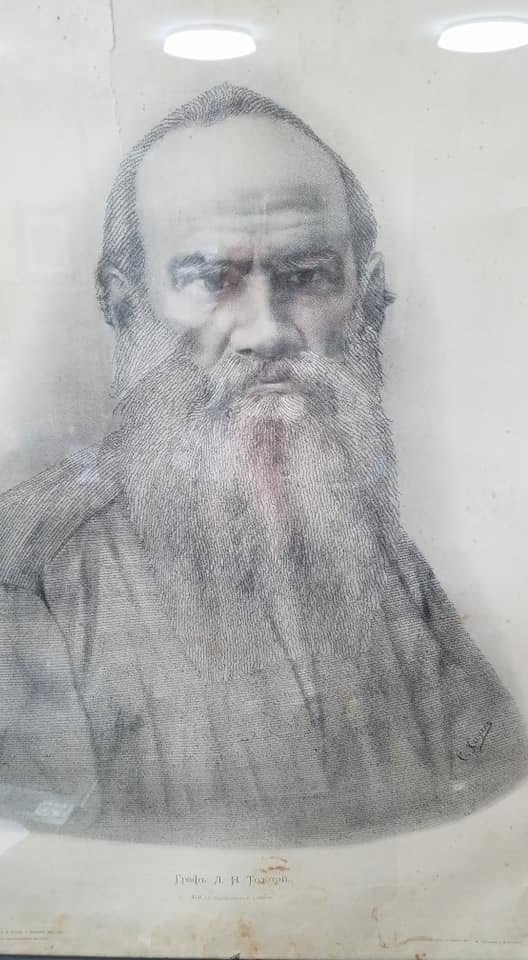
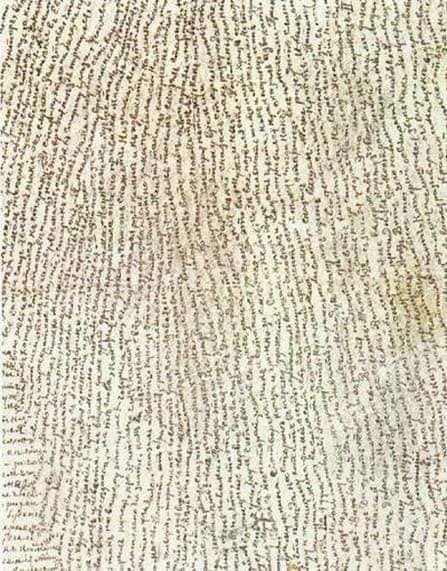
The story behind this work reads like a literary legend. According to one version, after yet another rejection by the Glavnoye Upravleniye po Delam Pechati (Main Directorate for Press Affairs, the tsarist censorship body), Khazin, a friend of Tolstoy, proposed immortalizing “The Kreutzer Sonata” in an unusual way. At first, the writer did not understand what was special about the image, but looking closer, he saw that almost the entire portrait was composed of his work. The image was restored at Bookvica in 2019—no longer just as a common book rarity, but as a work at the intersection of literature, graphics, and publishing experiment.
Tamar points out that many Soviet and pre-revolutionary books have been preserved in Georgia. According to her, this is partly due to the history of Tbilisi: wealthy families lived here and built up family libraries. Later, during the Soviet era, the culture of home bookshelves continued to develop. People stood in lines for books and were willing to spend their last money on them.
Rare Georgian editions, Tamar notes, are also found, but they are fewer and harder to find. The Russian-language layer is much more prominent on the market, as the majority of literature was published in Russian during both the tsarist and Soviet eras.
Today, according to Tamar, the demand for literature is not disappearing but merely transforming. Among the buyers are many young people with unexpected and specific interests: “They are always looking for something of their own.” For Tamar, working with books is an introduction to other people’s lives. Old editions preserve not only the text but also the traces of former owners, time, relocations, and entire eras. Through them, the history of Tbilisi itself can be read. Worn covers, yellowed pages, library stamps, and random marginalia turn each book into a unique object with its own biography. Once on a street stall, its journey does not end, but merely begins a new chapter