
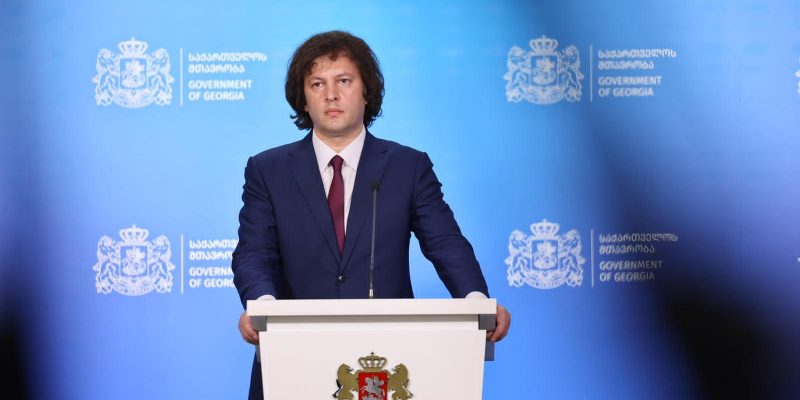

Following the outbreak of the war in Ukraine in 2022, a specific approach emerged within the opposition, pseudo-liberal minority of our society that warrants separate consideration, Chairman of Georgian Dream and Prime Minister of Georgia Irakli Kobakhidze wrote on social media.
According to him, shortly after the end of the war, “the leader of the regime personally greeted Russian citizens at the border and invited them to Georgia for tourism and business.” He added that during the same period, “the regime actively sought to deepen cultural and humanitarian ties with Russia.”
“As you know, as a result of the crime committed by the ‘United National Movement’ regime against its own state and people, Russia occupied 20 percent of Georgia’s territory. 18 years have passed since the 2008 August war, yet its heaviest toll still lies upon our country and the lives of tens of thousands of Georgians today. As a result of Russian military aggression, 412 people were killed and 2,232 were wounded; 30,000 of our fellow citizens were forced to flee their homes; more than 120 Georgian settlements ended up behind the occupation line. Before our homeland and history, we are obligated to realize that these figures are not mere statistics, because behind them stands what is most precious — lost lives, abandoned and destroyed villages, and national interests sacrificed to treason.
Remarkably, against the backdrop of a tragedy of such scale, the August war was not a sufficient ground for the ‘United National Movement’ regime and its followers in 2008–2012 to form a radical stance toward Russia. In reality, the opposite occurred — after Russia’s occupation of Georgian territories and its recognition of Abkhazia and South Ossetia as independent states in 2008, the ‘United National Movement’ not only failed to pursue a tough policy toward Russia, but shortly after the war ended, the regime’s leader personally met Russian citizens at the border and invited them to Georgia for tourism and business. During the same period, we saw active efforts by the regime to deepen cultural and humanitarian ties with Russia, as well as the ‘United National Movement’ authorities encouraging the involvement of Russian capital in various sectors of Georgia’s economy, including strategic ones, and a few years later — the unilateral abolition of the visa regime for Russian citizens,” notes Irakli Kobakhidze.
He further explained that “in the understanding of the foreign agency network, Russia became a true occupier of Georgia only after the occupation of Ukrainian territories.” According to him, these emotions displayed by the foreign agents are also completely fake, as they are devoid of any values.
“To illustrate this clearly once again: the rhetoric of foreign agents toward Russia was not so harsh and negative either before the 2008 war or after the August war — that is, when it directly concerned their (at least formally) homeland, when hundreds of lives of Georgian soldiers, police officers, and civilians fell victim to Russian occupation, when Giorgi Antsukhelidze was tortured to death, when we lost more than 120 Georgian villages, when tens of thousands of our fellow citizens became internally displaced persons, and when something occurred that Russia had not even contemplated before — Russia’s recognition of the so-called independence of the occupied territories of Georgia.
Foreign agents declared Russia a sworn enemy only after it invaded Ukraine for the second time. If we were talking about citizens of Ukraine, this would, of course, be completely understandable; but as it turns out, the hearts of these ‘rootless’ Georgian citizens bleed more for Ukraine than for Georgia, because that is the directive they received. It is a paradox, but a fact, that in their understanding Russia became a real occupier of Georgia not after the occupation of Georgian territories, but after the occupation of Ukrainian territories.
Naturally, these emotions of theirs are also completely fake, because foreign agents are devoid of any values, which they have repeatedly proven until now. However, a logical question arises — why did they become Russophobes now, and not when it concerned Georgia? Do they really not even formally recognize Georgia as their homeland, and is Ukraine their homeland? Logically, if anyone was to form a radical anti-Russian stance, it should have happened not after 2022, but after 2008. The fact that their current Russophobia is fake is confirmed by concrete facts. Without looking far, we all know that Russophobic politicians, ‘NGO-ers’, journalists, and activists have had no reaction whatsoever to the millions of Russian rubles transferred to Elene Khoshtaria from the state treasury of Russia,” Irakli Kobakhidze wrote on social media.