

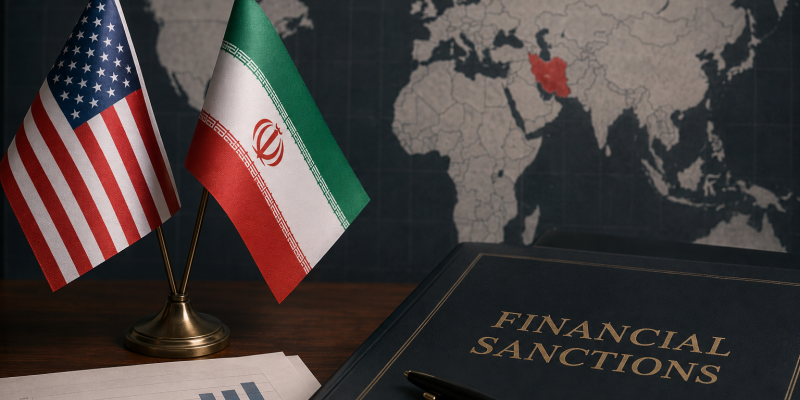

Economic D-Day: Washington is moving its confrontation with Iran into a new phase—shifting from sanctions on individual companies and officials toward an attempt to systematically isolate the entire Iranian economy. US Treasury Secretary Scott Bessent announced the launch of an “economic offensive on Iran’s financial ties across the world” aimed at severing the channels that allow Tehran to obtain foreign currency, technology, and revenue from foreign trade. And this new American strategy could affect Georgia.
“Iran now faces a crystal-clear choice: it has only two paths—total global isolation and a subsistence-based economy, or a path to normal life with the possibility of reconnecting with the global economy. We are launching Operation Economic Outcast to eliminate all other options available to the Iranian regime,” Bessent said at a press conference.
The new restrictions span five sectors at once—shipping, aviation, technology, gold, and digital assets—with around 60 individuals, companies, and vessels added to the sanctions lists. Concurrently, Washington is curtailing exemptions that previously permitted certain remittances, educational, and academic exchanges. However, the fundamental distinction of the current strategy lies not in the sheer volume of new sanctions, but in the intent to project American pressure far beyond Iran’s borders.
“The US Department of the Treasury has identified all the networks and intermediaries that Iran uses to smuggle oil and evade sanctions. Starting today, we will shut down all revenue streams that fund the IRGC and the Iranian regime. We are applying a ‘zero leakage’ principle—leaving the regime with no room to recover. It is no longer possible to remain in the gray zone: countries can no longer turn a blind eye to aiding Iran.”
From now on, Washington’s primary weapon is the dollar. The US is warning foreign banks, companies, and intermediaries: any entity that assists Iran in laundering money or evading restrictions risks losing access to the United States financial system. Furthermore, specific countries will be given deadlines to wind down the cooperation with Tehran identified by Washington.
In effect, the US is attempting to force Iran’s trading partners to choose between the Iranian market and access to the US dollar and American financial infrastructure. Bessent asserts there will be no more “gray zone.” The new strategy is designed to make economic ties with Iran so costly and perilous that even nations that do not politically align with Washington will scale them back out of sheer pragmatism.
“Every country has a specific deadline to end the activities we have identified. If they do not take action, we will do so unilaterally through Treasury authorities. And let me be clear: any institution that facilitates money laundering on behalf of Iran will be cut off from the US dollar system. The clock is ticking,” Bessent stated.
Georgia: The Primary Risks Are Banks, Transit, and Business Over-Compliance
For Georgia, the most sensitive consequence may not be an outright ban on trade with Iran, but the necessity of exercising much tighter control over any transactions involving Iranian participation. The US strategy is now specifically targeted at intermediaries: banks, freight carriers, shipping companies, and entities dealing in gold, technology, and digital assets. Moreover, Bessent effectively warned that Washington is prepared to penalize not only the violator itself, but also any foreign bank facilitating a significant transaction with a sanctioned entity.
For Georgian banks, this creates a straightforward choice. Access to dollar settlements and correspondent relationships with Western banks are incomparably more vital than revenues generated from servicing Iranian business. Consequently, even legitimate transactions could face heightened scrutiny regarding source of funds, ultimate beneficial owners, and payment purposes. In practice, this gives rise to the risk of so-called over-compliance: financial institutions begin refusing even formally lawful transactions if they perceive an elevated probability of a sanctions breach.
The second issue is transit. Geographically, Georgia is part of transport corridors linking the Black Sea, the North Caucasus, Turkey, Armenia, and onward to Iran. If Washington genuinely begins systematically tracking supply chains, special scrutiny will fall on dual-use goods, technology, aviation components, maritime freight, and re-export schemes. This is precisely where political risk emerges for Tbilisi: the US may demand not merely compliance with existing sanctions, but active measures to prevent Georgian territory and its financial system from being used for sanctions circumvention.
There is also an indirect economic effect. If the US campaign curtails Iranian oil even further or if tensions around the Strait of Hormuz escalate once more, the fallout will reach Tbilisi via global energy prices. As Georgia is a fuel importer, a protracted oil shock could spill over into gasoline and transport costs, ultimately driving up inflation.
Armenia: A Far More Serious Problem
For Armenia, the new US strategy is potentially much more painful, because Iran is not merely one of its trade partners, but an immediate neighbor and a crucial pillar of its economic and energy diversification. Consequently, Washington’s demand to phase down economic ties with Tehran confronts Yerevan with a far more difficult dilemma than Tbilisi.
The energy sector is particularly sensitive. Armenian-Iranian relations encompass cross-border energy infrastructure and electricity-for-gas swap arrangements. If the US begins interpreting economic ties supporting Iran in the broadest possible sense, Yerevan will need either to seek waivers or to prove to Washington that specific transactions do not fall under sanctions restrictions.
The measures announced by Bessent do not in themselves signify an immediate, automatic cessation of all Armenian trade with Iran. Washington is speaking of timelines for winding down designated activities and secondary sanctions targeting specific significant transactions, rather than an immediate, total blockade of all contact.
Yet for Armenian banks, the threat of being cut off from the US dollar system is particularly acute. If a financial institution is determined to have knowingly facilitated significant transactions for sanctioned Iranian entities, OFAC (the Office of Foreign Assets Control, an agency of the US Department of the Treasury) has mechanisms to restrict its correspondent accounts in the United States. Consequently, banks will almost certainly vet Iranian clients, companies with Iranian beneficial owners, and cross-border payments with far greater scrutiny.
There is also a strategic dimension. Total economic isolation of Iran objectively narrows Armenia’s foreign policy room for maneuver. Yerevan is invested in maintaining good relations with Washington while simultaneously preserving working ties with Tehran. Therefore, the more rigidly the US frames the choice as “either the American financial system or economic ties with Iran,” the harder it will be for Armenia to balance between the two.
What Matters for Both Countries
At this stage, it is premature to claim that Georgia or Armenia are already under direct threat of US sanctions. Washington is currently intentionally leaving room for adjustment: the US Treasury Secretary stressed that partners would be given an opportunity to modify their conduct.
However, if the operation announced by Washington—Economic Outcast—truly transitions from warnings to the rigorous enforcement of secondary sanctions, Georgia will face immediate challenges regarding banking compliance, transit corridors, and energy prices. For Armenia, preserving a vital economic and energy pillar of its foreign policy will take center stage. And it is Armenia that may become one of the regional countries forced to negotiate most meticulously with Washington for exemptions and permissible forms of cooperation with Iran.
Iran “Knows How to Play This Game”
US sanctions against Iran have been in place for decades, leaving much of its direct economic ties with the West already dismantled. Now Washington is attempting to strike directly at the circumvention infrastructure—third-country settlements, trading intermediaries, shippers, cryptocurrencies, gold transactions, and above all, oil exports. China—the largest buyer of Iranian crude—is taking on critical importance. Bessent pointedly warned that “no one is immune” from US sanctions.
“Every country has a deadline to end identified cooperation with Iran. Otherwise, we will take action ourselves. Any entity helping Iran launder money will be excluded from the US dollar system. The clock is ticking.”
And herein lies the key test of the American strategy: it is one thing to compel small states and private banks to abandon trade with Iran, but quite another to achieve the same from major powers capable of developing alternative financial and trade mechanisms. Tehran is banking precisely on this vulnerability. Iranian Foreign Ministry spokesperson Esmaeil Baghaei described secondary sanctions as a violation of state sovereignty and an attempt by the White House to extend its domestic jurisdiction over the rest of the world:
“The US, lacking any basis in international law, is coercing other countries to sever trade ties with Iran. In doing so, Washington is undermining one of the core principles of the UN Charter—national sovereignty. This is a warning to all countries.”
Parliament Speaker Mohammad Bagher Ghalibaf even asserts that Iran’s trading partners have already made it clear they do not intend to comply with US demands.
“The Americans know that no one believes their loud declarations; the United States is not in an economic position to further restrict its relations with other countries. Iran’s trade partners, both in the media and in messages sent to us, have made it clear that they are disregarding these statements everywhere.”
Even more telling is the statement by Economy Minister Ali Madanizadeh. According to him, Tehran anticipated such a move by Washington, prepared a two-year counter-strategy, and “knows how to play this game.”
“We have long anticipated this and were prepared. The government has a two-year plan to counter economic pressure. But this time our response will not be purely defensive—they should expect an offensive as well. The era of the unipolar world is over: two major powers have already rejected the new sanctions, and we are confident that many others will also refuse to support them.”
Behind this outward confidence lies a rational calculation: Iran does not necessarily need to completely neutralize the sanctions—it only needs to sustain minimally resilient channels for exports and settlements so that the total isolation strategy fails to achieve its stated objective. However, American pressure is becoming especially hazardous for Tehran because the economic and military dimensions of the crisis are now directly linked. Pentagon chief Pete Hegseth emphasizes that the US “by no means” rules out new strikes in the Hormuz area or against Iran itself.
“If we need to use kinetic strikes, we will use them. If Iran is foolish enough to overplay its hand or start messing with the US military, we will do what is necessary. But the economic pressure, as we know, is hurting them the most right now. Of course, we by no means rule out the use of kinetic strikes anywhere, in the Strait of Hormuz or around Iran,” Hegseth stated.
What emerges is a two-track strategy: Washington first attempts to compel Tehran to yield through financial isolation, keeping military force in reserve as the next level of escalation. Iran responds in kind—vowing to weather the sanctions while retaining the capability to drive up their cost through leverage over Hormuz and regional security. Therefore, the success of Bessent’s proclaimed “economic D-Day” will not be measured merely by the number of blocked companies and frozen accounts.
If the US genuinely manages to compel China and other major partners to significantly curtail Iranian oil purchases, shut down alternative settlement channels, and simultaneously preserve relatively normal navigation in the Persian Gulf, Tehran’s position will become significantly more precarious. If, however, Iran maintains sufficient external conduits and retaliatory pressure around Hormuz pushes oil prices upward once more, part of the cost of the American campaign will be borne by the global economy—including the US itself.