

Comment from the EU Delegation
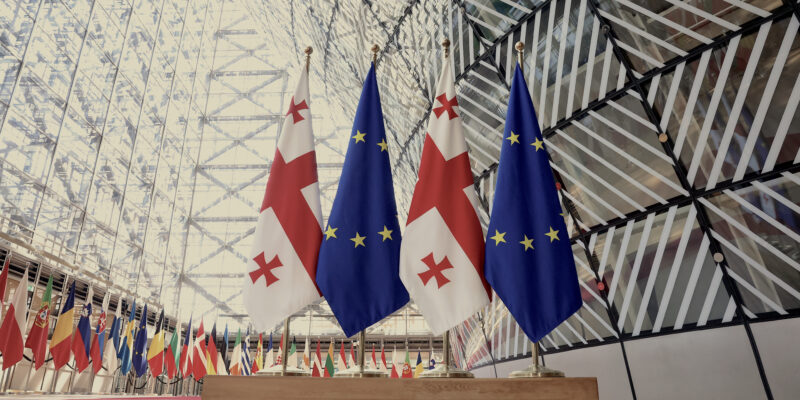
On November 4, the European Commission will present the “2026 Enlargement Package” in Brussels. According to the EU Delegation to Georgia, the package includes the Communication on EU Enlargement Policy and reports detailing the progress made by candidate and potential candidate countries—Montenegro, Albania, Ukraine, Moldova, Serbia, North Macedonia, Bosnia and Herzegovina, Kosovo, Turkey, and Georgia—along their path toward EU accession.
The document evaluates how each candidate country is implementing the reforms required for European Union membership. According to the EU Delegation, a press conference will take place in Brussels, after which EU Ambassador Paweł Herczyński will present the report’s key findings on Georgia in Tbilisi and take questions from journalists.
“In its annual report, the European Commission assesses the progress of candidate countries on their path to European Union membership—including Georgia, as it holds candidate status. The report is published annually, the criteria are clear, and the standards are entirely identical for all.
In December 2023, the European Union granted Georgia candidate status on the condition of delivering on key reforms known as the ‘nine steps.’ These nine steps primarily entailed implementing reforms in the spheres of democracy, the rule of law, and the protection of human rights.
Candidate status is a significant milestone that entails clear obligations. These obligations are inextricably linked to the ‘fundamentals’ of the EU accession process.
Democracy, the rule of law, and human rights form the very foundation of EU membership. These fundamental principles are binding on all candidate countries. Adherence to them cannot be selective.
Without progress on these fundamentals, advancing along the path toward EU accession is virtually impossible: the EU is a union built upon shared values,” the EU Delegation in Tbilisi said in a statement.
Key Takeaways from the Communication
Meanwhile, Radio Free Europe/Radio Liberty’s Georgian Service has obtained a draft of the European Commission’s enlargement communication, titled “A Stronger Europe Through Enlargement,” which is set to be presented today to the European Parliament, the Council of the EU, and other institutions.
In the concluding section dedicated to Georgia, the communication notes that over the past year, the country has witnessed a “continuous backsliding on the fundamentals, confirming that Georgia continues to be an EU candidate country only formally and continues to renounce the benefits that candidate status and the accession process bring.”
“The ruling party of Georgia continues to undermine the country’s European path through attacks on democratic principles, the rule of law, and fundamental rights, while facilitating further state capture.”
The EU’s executive body reminds Georgian Dream [the ruling party] of the “nine steps”—the set of recommendations that accompanied the granting of candidate status to Georgia:
“As a result of increasingly repressive legislation, civic space is shrinking ever more severely. Georgia continues to fall short of fulfilling the nine steps identified by the European Commission as accompanying recommendations to candidate status.”
The communication underscores that the crisis triggered by democratic backsliding puts the visa-free regime at risk, which has thus far been suspended only for select categories of the country’s citizens:
“Georgian authorities have failed to address concerns over democracy and fundamental rights in the country, leading the EU to suspend the visa-free regime for holders of Georgian diplomatic, service, and official passports, thereby putting the functioning of the visa-free regime as a whole at risk.”
The document delivers a highly critical appraisal of the environment in which the 2025 local self-government elections were conducted. The report also notes that “civil society operates in repressive conditions and is targeted by restrictive legislation, amplifying a chilling effect.” Furthermore, it highlights that judicial independence is “severely undermined, particularly in Turkey and Georgia,” and that restoring public confidence in the judiciary remains an especially acute challenge in both countries.
Analyzing the scale of corruption across candidate nations, the authors highlight an “evident threat of state capture,” ranking Georgia first among the countries facing such risks, followed by Bosnia and Herzegovina, Serbia, and Turkey. Among other critical observations is a further decline in Tbilisi’s level of alignment with the EU’s Common Foreign and Security Policy (CFSP).
At the same time, the European Commission reaffirms its steadfast support for the nation’s sovereignty and the aspirations of Georgian society:
“The EU’s long-standing support for Georgia’s independence, sovereignty, and territorial integrity remains unwavering, as does its support for the European aspirations of the Georgian people.”
The concluding section of the document states that Georgia’s European integration could resume if the country’s leadership reverses its policy trajectory of recent years:
“Should the Georgian authorities decide to reverse course and re-commit to the fundamentals of EU accession—democracy, the rule of law, and fundamental rights—the country’s path toward the European Union could be resumed. The European Commission would welcome such a resumption, given the strong people-to-people ties and the broad, steadfast support of the Georgian people for a democratic European future.”
Georgia formally applied for EU membership in March 2022. Candidate status was granted to the country in December 2023. Earlier, at the June 2023 EU summit, unlike Ukraine and Moldova, which were granted candidate status, Georgia was granted a “European perspective,” contingent upon fulfilling 12 priority areas necessary to rehabilitate its democratic institutions.
On November 28, 2024, one month after the parliamentary elections, Prime Minister Irakli Kobakhidze announced that the Georgian government was shelving the opening of EU accession negotiations until the end of 2028 and declining EU budget grants. The decision sparked massive street demonstrations, which were met with harsh crackdowns.