


The Georgian government intends to fundamentally overhaul the country’s education system. Critics view this as an attempt to tighten state control over universities. This conflict extends far beyond education policy: since the eras of Russian imperial and Soviet rule, education in Georgia has been intrinsically linked to the struggle for national self-determination.
A young woman is looking for the way to the university. Asking for directions in Georgian, she receives a response from a passerby in Russian: “I don’t understand you.” Another woman explains that she is on Bidzina Ivanishvili Street—named after the billionaire who amassed his fortune in Russia and is widely regarded as the most powerful figure behind the ruling Georgian Dream party. However, this street, she says, does not lead to education.
“Then why do we need a road that doesn’t lead to education?”, the young woman asks.
The video ends with a portrait of Giorgi Antsukhelidze—a national hero who was tortured and killed in captivity during the 2008 Russo-Georgian war—alongside the EU flag and the slogan: “Our choice is Ilia’s path.”
The video, released in late October 2026, became part of a campaign by the student movement “Defend Iliauni” protesting the Georgian government’s education reform.
The slogan references Ilia Chavchavadze, one of the foremost ideologues of the Georgian national movement, who in the 19th century championed the advancement of education and the cultural self-determination of a country under Russian imperial rule.
Today, one of Georgia’s leading liberal universities bears his name. And it is precisely Ilia State University (Iliauni) that stands to lose a substantial portion of its academic autonomy as a result of the planned reform.
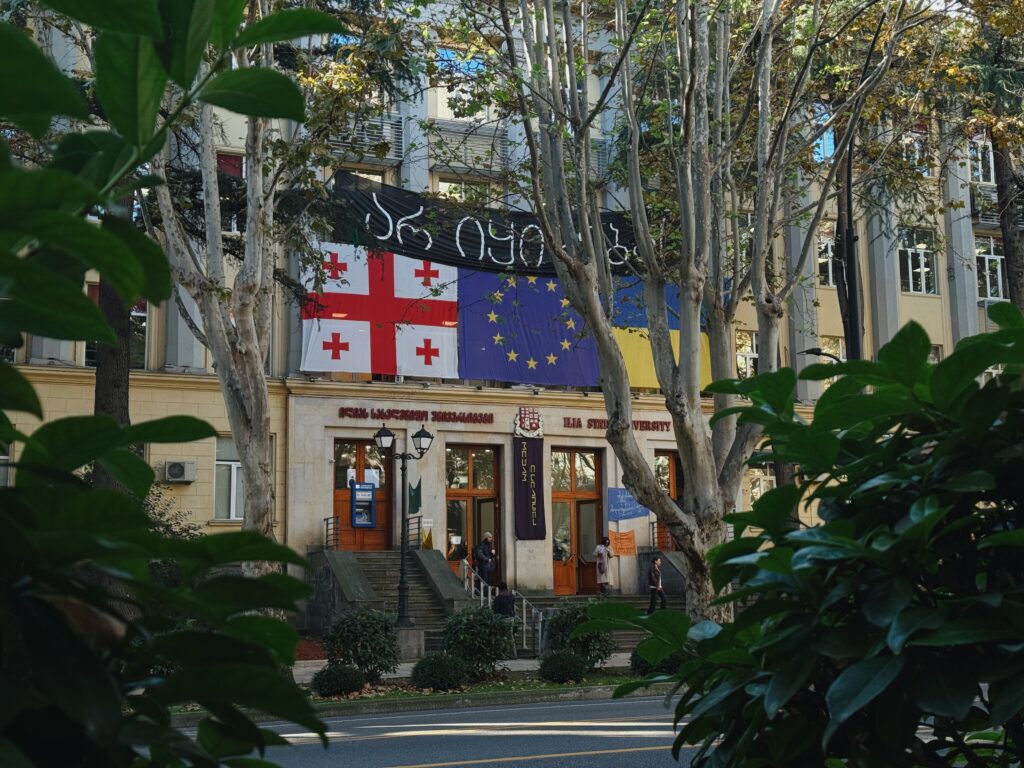
“The Main Goal Is to Establish Control”
The Georgian government is planning sweeping transformations across the education system. In schools, authorities plan to introduce mandatory school uniforms and standardized textbooks. In addition, the duration of secondary education is to be reduced from 12 to 11 years. Critics warn that this could make it harder for Georgian graduates to gain admission to European universities, many of which require 12 years of formal schooling.
The reform comes amid a sharp deterioration in relations between Tbilisi and Brussels. Georgia’s accession process to the European Union has been effectively frozen.
Even more contentious is the proposed reform of higher education. Under the principle of “One City – One Faculty,” identical academic programs within a single municipality are slated to be merged into a single university. The government justifies this measure by citing the need for a more efficient allocation of resources. Critics warn, however, that this could diminish academic diversity and compromise university autonomy.
The changes could hit Ilia State University especially hard. Over the past two years, it has emerged as a key focal point for pro-European protests. Transferring its faculties to other institutions and the potential termination of internationally accredited degree programs could critically weaken the university, even though no official shutdown is formally planned.
Political scientist and former Georgian Minister of Education Ghia Nodia argues that the reform bears an unmistakable resemblance to Soviet mechanisms of control.
“If you look at the general trajectory of the reform, the ideological assumptions underpinning it, and certain institutional elements—particularly the Ministry of Education’s control over the entire system—we are returning to Soviet standards and Soviet thinking,” Nodia says.
The ruling Georgian Dream party, which originally came to power on pro-European pledges, increasingly casts itself as a guardian of traditional values and national sovereignty against Western pressure. Critics accuse it of dismantling democratic institutions and drifting closer to Moscow, even though Georgia has maintained no formal diplomatic ties with Russia since the 2008 war.
From Saint Petersburg to Bologna
The dispute over universities in Georgia has deep historical roots. In the era of the Russian Empire, education served not only as a conduit for imparting knowledge, but also as an instrument of imperial governance.
As historian Amiran Urushadze explains, the Tsarist administration viewed the education of Caucasian elites as an instrument of political integration and “pacification” of the region. A proposal to reform the Tiflis Nobility School explicitly stipulated that its graduates should propagate the “Russian way of life” far beyond the school walls.
At the same time, academic institutions in the imperial center claimed the exclusive authority to study, define, and interpret the history and society of the Caucasus.
The Georgian national movement countered this by demanding the establishment of its own system of higher education. In 1918, during Georgia’s brief period of initial independence, historian Ivane Javakhishvili founded Tbilisi State University.
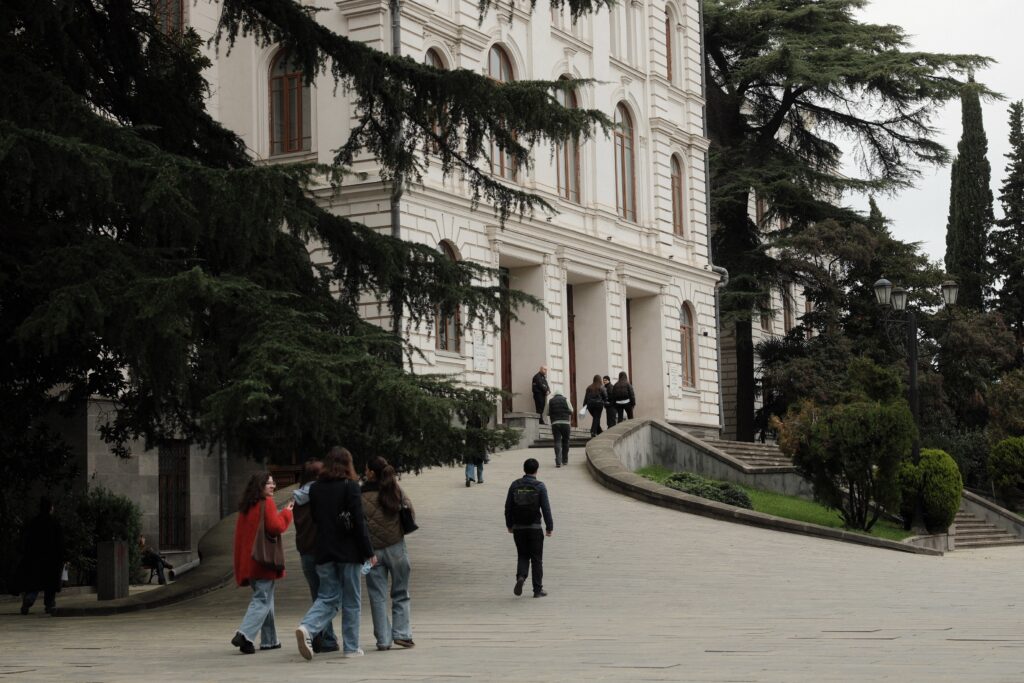
According to philosopher Giga Zedania, this was a direct response to plans by the Imperial Academy of Sciences in Saint Petersburg to establish a unified “Caucasian” university with Russian as the language of instruction.
Georgian intellectuals, by contrast, sought to establish a national university that could independently determine its language of instruction and scientific priorities. Georgia was no longer to remain merely an object of academic inquiry directed from beyond its borders. The founding of the university was also an act of intellectual self-determination.
Following the Sovietization of Georgia in 1921, the higher education system was once again brought under Moscow’s centralized control. Science and teaching were subordinated to ideological imperatives, and academic freedom remained severely restricted.
Following the collapse of the Soviet Union in 1991, Georgia began restructuring its education system. The most far-reaching transformations took place after the 2003 Rose Revolution. Under President Mikheil Saakashvili, a three-tier system of higher education was introduced alongside unified national examinations, which dramatically curtailed widespread corruption in university admissions. English gained increasing precedence over Russian, and accession to the Bologna Process strengthened institutional ties with Europe.
Yet European integration did not automatically dismantle legacy power structures. The question remained open as to how far universities had truly attained the freedom to independently determine their research agendas, pedagogical approaches, and institutional trajectories.
The Long Shadow of Homo Sovieticus
“More than 35 years have passed, but Soviet psychological and cultural mindsets still endure,” says Ghia Nodia. “You cannot simply ship the older generation off to Mars and rely exclusively on the new one.”
Just how deeply entrenched these mindsets remain is illustrated in “Deconstructing Inequity,” a study on the desovietization of Georgian higher education by Anatoly Oleksiyenko, a scholar of education at the Education University of Hong Kong.
One Georgian university professor told the researcher that out of fear of retribution, scholars could utter only “half-truths.” For this reason, disciplines such as sociology, political science, and philosophy were able to develop fully in Georgia only relatively recently.
Other participants in the study described an academic culture in which professors were treated as infallible authorities, while dissenting views were dismissed as ideological deviations.
The Soviet educational apparatus was thus designed to produce a compliant, uncritical, and obedient individual: the Homo Sovieticus, or “Soviet person.”
To be sure, the concept of Homo Sovieticus itself carries the risk of reducing complex societal challenges to an alleged, monolithic Soviet mentality.
Oleksiyenko’s research also reveals that even pro-Western reforms were frequently implemented using Soviet-style top-down models. Decisions were routinely handed down from above. At times, English proficiency was prized above decades of pedagogical experience.
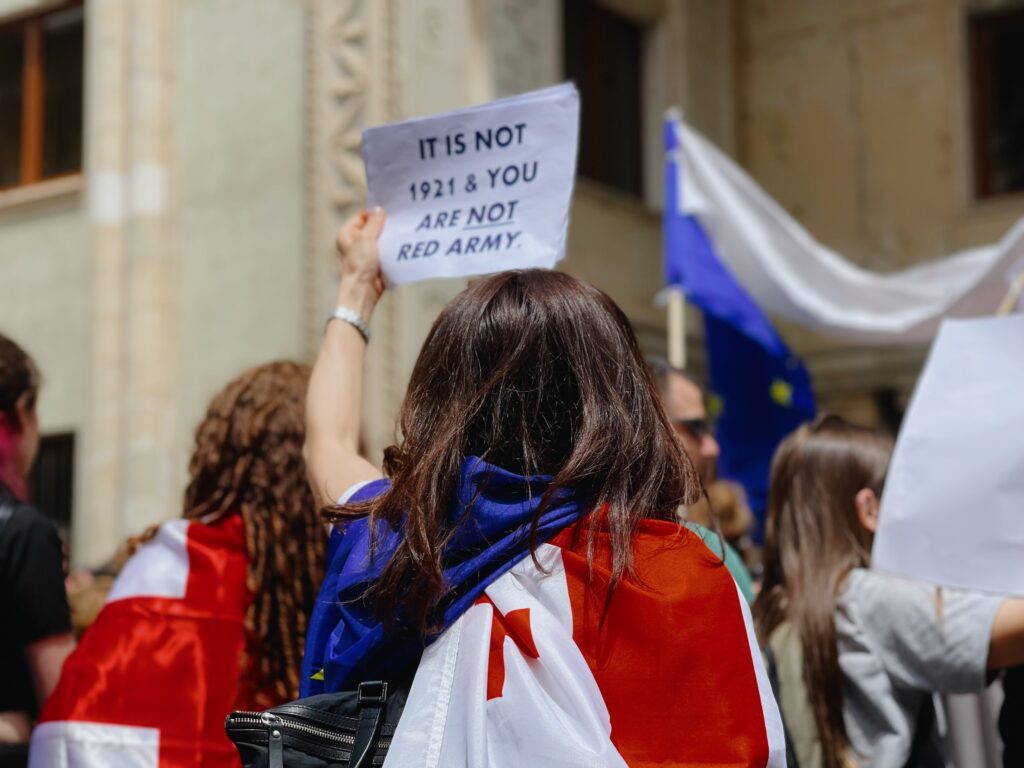
A Generation Between Two Educational Worlds
The lived experiences of two young Georgians demonstrate how academic environments shape ways of thinking.
Elene studied international law at Tbilisi State University and spent an exchange semester in Finland. There, she encountered an entirely different dynamic between faculty and students.
“Based on my experience in school and during my undergraduate studies, education in Georgia often means being in an environment where professors regard their knowledge and teaching methods as the only correct ones,” she explains.
According to her, those who study exclusively in Georgia run the risk of remaining trapped within a closed system, without ever being exposed to alternative perspectives.
“I’m not saying one path is inherently better than the other,” Elene stresses.
She plans to pursue further studies in Europe, but intends to return to Georgia in the future to put her knowledge to work and share her experience.
Dato, by contrast, intends to leave the country. Born in Tbilisi, he attended school in Moscow before graduating from the Moscow Institute of Physics and Technology (MIPT)—one of Russia’s elite technical universities. Later, he earned an MBA from London Business School.
“My Russian technical education gave me a rigorous scientific foundation. But studying in the UK completely transformed my worldview,” he says.
“Had I not left for London, I would likely have remained a much more conservative person. English as a medium of communication opened the door to an entirely different world.”
Looking back, Dato describes his years in Moscow as living behind an Iron Curtain that had, in fact, fallen long before.
“Only after stepping outside that hermetic world did I realize that I belong to a much broader world than the one I had previously identified with.”
At the same time, Dato does not question the academic caliber of the Russian education he received. Rather, his experience suggests that academic excellence and intellectual openness are not necessarily the same thing.
Whose Future Is It?
The Georgian government frames the reform around modernization and optimizing university efficiency. Critics, meanwhile, fear a renewed centralization of the system that could strip independent universities of their autonomy and influence.
The current reform cannot be equated outright with the educational policies of the Russian Empire or the Soviet Union. However, it revives a historic question: who decides what knowledge students receive, and how independent can scientific and educational institutions truly remain?
For the protesting students, what is at stake goes far beyond the fate of specific university faculties. Their invocation of “Ilia’s path” serves as a reminder of the enduring struggle for education as an indispensable prerequisite for national self-determination.
More than a century later, Georgia once again confronts the fundamental question of who will chart its educational path.