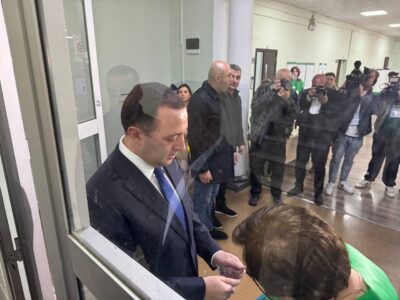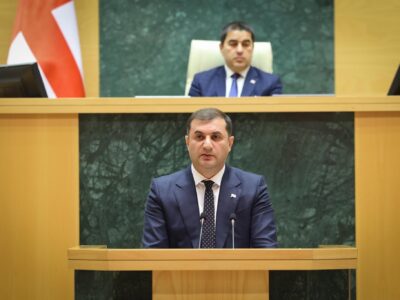


Belarus is prepared to facilitate conditions for negotiations between Georgia and Russia, the country’s Minister of Foreign Affairs Maxim Ryzhenkov stated. He made the remarks while commenting on the inaugural meeting held in Minsk on November 19 between special envoys from Tbilisi and Moscow, Giorgi Zurabashvili and Mikhail Galuzin.
Speaking at a press conference following a joint session of the collegiums of the diplomatic services of Russia and Belarus in Gomel, Ryzhenkov said that such dialogue is fully aligned with the initiatives of President Alexander Lukashenko and the Belarusian Ministry of Foreign Affairs aimed at defusing tensions and fostering mutual trust among countries in the region.
“This applies especially to nations and peoples with whom we share deeply rooted and long-standing ties. Naturally, we cannot remain indifferent to a situation where there is a certain tension between Georgia and Russia—countries close to us. It requires a resolution. That is why we contributed to creating conditions for talks on Belarusian soil between representatives of the foreign ministries of the two countries,” he noted.
According to the Belarusian foreign minister, the talks between Zurabashvili and Galuzin in Minsk proved productive.
“We are pleased that during these lengthy and quite substantive discussions—as reported by representatives of both sides—the countries made significant progress in strengthening mutual trust. Direct dialogue between them is now feasible. We consider this the most important positive outcome of the talks on the Belarusian platform. There is nothing more reliable than when parties reach a level of mutual understanding that allows their representatives to visit one another and discuss pressing concerns,” Maxim Ryzhenkov said.
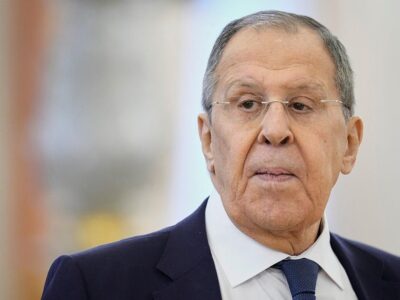
In remarks to reporters in Gomel, Russian Foreign Minister Sergey Lavrov also commented on the launch of talks between Moscow and Tbilisi. He expressed gratitude to his Belarusian counterparts for hosting the dialogue and added that Russia is interested in normalizing relations with Georgia.
As a reminder, on November 19, Minsk hosted the first meeting between the Georgian Prime Minister’s Special Representative for Relations with Russia, Giorgi Zurabashvili, and Russian Deputy Foreign Minister Mikhail Galuzin.
According to a statement by the Government of Georgia, the sides “reached a number of agreements.” The Georgian government did not elaborate on their specifics. It was also noted that Zurabashvili and Galuzin addressed trade, economic, cultural, and humanitarian relations, as well as current challenges in these areas.
“The need to continue dialogue in order to achieve tangible results was emphasized.”
Furthermore, the parties discussed the regional security situation.
The Russian Ministry of Foreign Affairs released a similar statement. Moscow stated that Zurabashvili and Galuzin held a “thorough exchange of views on topical issues of bilateral engagement, focusing on trade, economic, cultural, and humanitarian cooperation.”
“A number of practical agreements were reached. Regional security issues were discussed,” the Russian Foreign Ministry noted.
The ministry’s official spokesperson, Maria Zakharova, later commented on the meeting as well. According to her, the parties held a “thorough exchange of views on current issues of bilateral engagement, primarily in the trade, economic, cultural, and humanitarian spheres.” Zakharova added that this negotiation format would continue in the interest of further developing cooperation between Moscow and Tbilisi.
Georgian Foreign Minister Maka Bochorishvili, for her part, stated that the negotiation format with Russia is necessary, as it addresses issues driven by “the interests of Georgia and the interests of its citizens”: “These matters require, above all, urgent discussion and direct dialogue.” The minister also added that the Georgian side had no objections regarding the selection of Minsk as the venue for the first meeting between the two countries’ special representatives.
On November 22, Russian Deputy Foreign Minister Mikhail Galuzin announced that Moscow and Tbilisi had agreed to hold direct talks on a regular basis.