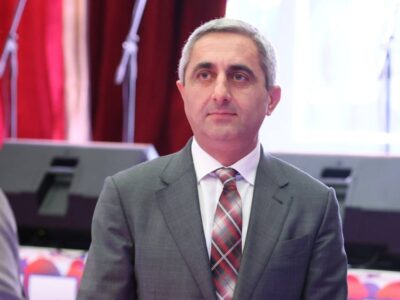

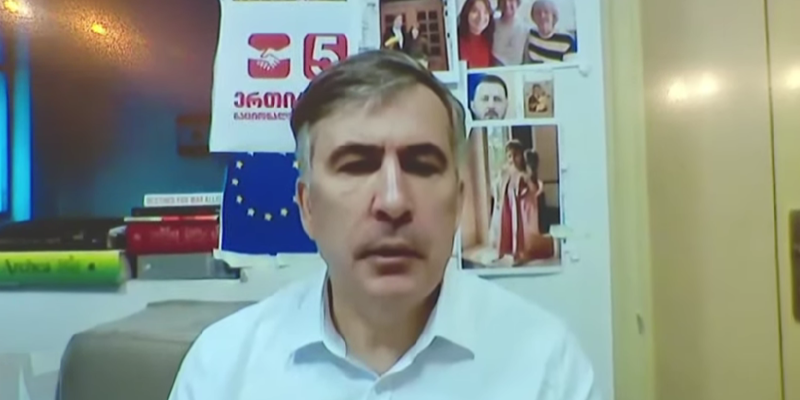

Georgia’s third president is calling on the opposition to “stop personal infighting” and focus on the primary goal—to “consign the most destructive, cynical, and cruel regime in Georgia’s history to oblivion.” On his Facebook page, Mikheil Saakashvili writes:
“The dictatorship is actually faltering; it is weaker than ever, and recent days confirm this. A massive vacuum has formed, which active citizens and the opposition must fill. To avoid failing this time, we must urgently analyze all our mistakes and draw useful conclusions. I have decided to speak as openly as possible and do not intend to spare anyone’s feelings—if we want to gain strength, we must be able to accept criticism.
It was a major mistake to cede the theme of national patriotism to the ‘Kotsi’ [a derogatory term for the ruling Georgian Dream party], whereas the National Movement’s government was deeply patriotic and healthily nationalistic, while the current authorities have reduced patriotism to a cynical imitation and are effectively selling out the country. We failed to explain this properly.
A serious mistake was ignoring the issue of war and peace—it was necessary to explain that it is precisely the ‘Kotsi’ policy of capitulation, disarmament, and the loss of allies that leads to war.
An especially significant mistake is the almost total disregard for social issues, which gives people the impression that the opposition lives well and is uninterested in the problems of citizens, focusing mainly on self-promotion and internal squabbles.
It is a mistake to completely replace politics with street protests—the street is important, but without politics, it will be difficult. It is also a mistake to effectively retreat into internal emigration, shirk responsibility, and rely solely on the West, constantly guessing ‘what Rubio called about’ or ‘what Aliyev brought,’ instead of thinking about what we ourselves should do—this is harmful.
Going in circles yields nothing. Setting dates without proper explanation also produces no results, as we have seen many times.
At the same time, the greatest threat to the regime was posed by spontaneous actions, such as ‘Gavrilov’s Night’ and the protests following Kobakhidze’s statement (as well as international experience—Kyiv 2014, Nepal 2025), which could have led to a change of power if the political spectrum had been ready. But spontaneous protests do not arise on their own—they are the result of accumulated protest energy formed through constant work with the people. And this work cannot be limited to television or social media.
Ratings for all television channels, both pro-government and opposition, have dropped sharply. In social media, we rotate within the same ‘bubble,’ which, on the contrary, reinforces fragmentation.
It is necessary to identify specific problems and work on them by creating active groups. The idea that ‘first we change Ivanishvili, and then all problems will solve themselves’ is fundamentally wrong. How can he be replaced without working on the ground?
Approaches where the opinion of a narrow circle is more important than that of the broad masses are also flawed—this makes it easier to neutralize the opposition, turning it into a convenient target.
On the contrary, local groups working on specific issues create difficulties for the regime and achieve small victories that can eventually grow into a major victory, generating nationwide protest energy.
I also disagree with the thesis that only a strong leader can change the situation. This was relevant during the ‘Rose Revolution,’ but back then Shevardnadze was not a dictator, nor was Orbán. Here, we are dealing with a dictatorship, and therefore various groups, through asymmetric actions and uniting at the right moment, will be able to overthrow it.
What should happen after a change of power? The idea that only a coalition government will save Georgia is currently popular. Despite the criticism, I will say that a coalition government is the worst form of democratic governance because it leads to political corruption: resources are spent not on the people, but on maintaining the coalition. Furthermore, it is more difficult to make decisions in such conditions.
One of the main weaknesses of the opposition is its predictability for the regime. Overall, the opposition must stop moving along a pre-set trajectory and going in circles, refuse to accept money from entities planted by the regime even at the cost of ‘minor compromises,’ end personal infighting, and correctly target the most destructive, cynical, and cruel regime in Georgia’s history to send it into oblivion along with the people,” Saakashvili writes.