


Photo: Photolure
While the Georgian authorities speak of a “reset” in relations with the United States and demonstrate a readiness to restore their strategic partnership, Washington is increasingly strengthening its ties with Armenia. Almost simultaneously with a State Department delegation’s visit to Tbilisi, the US signed a package of strategic agreements with Yerevan covering security, energy, technology, and transport. Experts warn that Tbilisi risks permanently losing its role as the West’s key ally in the South Caucasus.

“We are extending a hand.” With these words, Georgian Prime Minister Irakli Kobakhidze chose to demonstrate Tbilisi’s readiness to restore its strategic partnership with the United States. The head of government recalled that this level of relations had been suspended by the previous White House administration and expressed hope that Washington is ready to start cooperation “with a clean slate.”
Kobakhidze made his statement in connection with the visit of a US State Department delegation to Tbilisi—Special Assistant to the Secretary of State Charles Yockey and representative of the Bureau of European and Eurasian Affairs Peter Andreoli.
The stated goal of the meetings in Georgia is to find ways to improve bilateral relations.
“We clearly outlined our position on this issue from the very beginning, we were waiting for the position of the American side, and we are glad that positive trends have been observed recently,” Kobakhidze said.
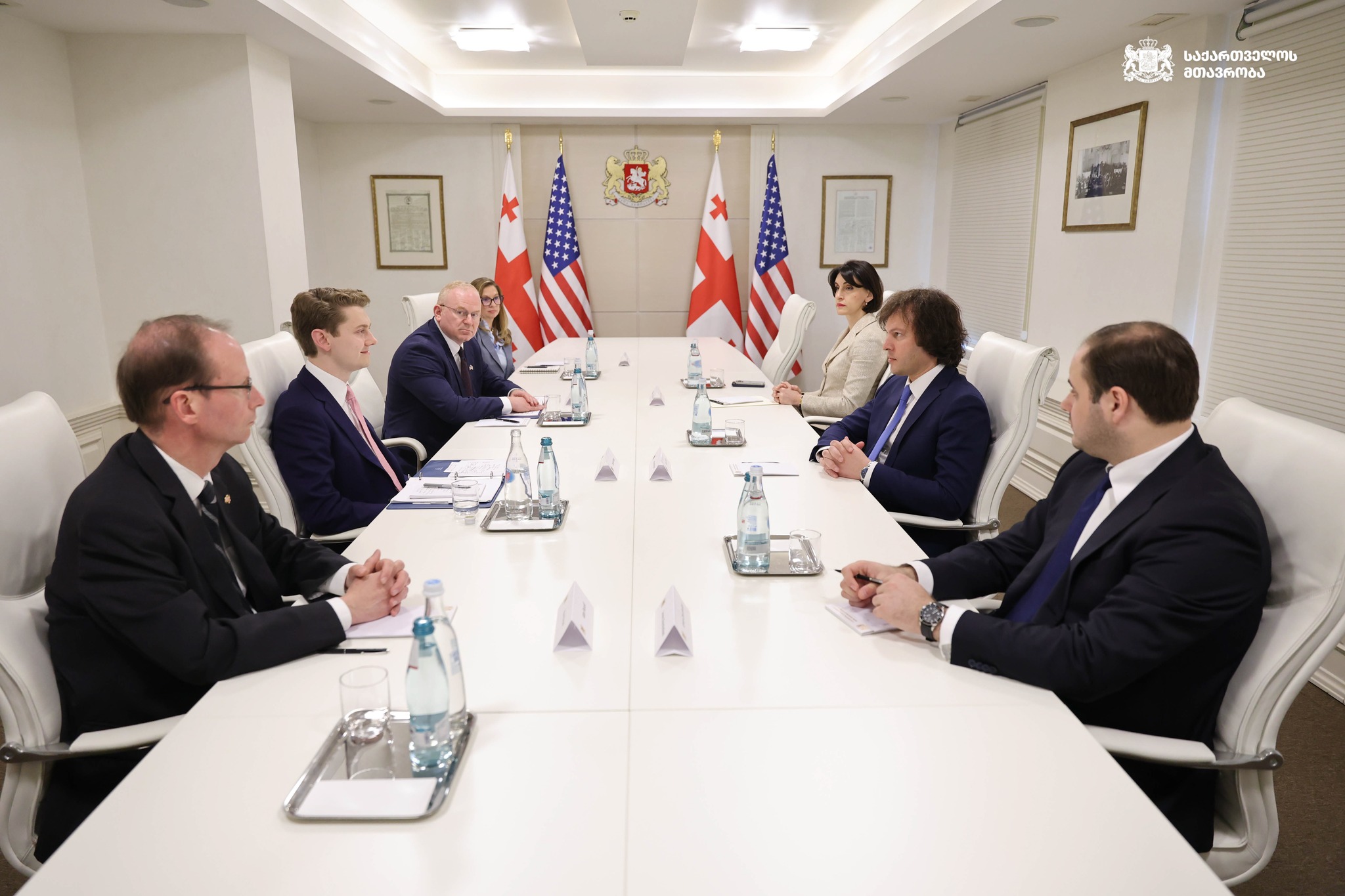
Georgia’s Ministry of Foreign Affairs (MFA) expressed a similar sentiment—its head, Maka Bochorishvili, also met with the State Department delegation: “Both sides expressed a firm readiness to continue working on strengthening bilateral cooperation.” A special emphasis was placed on the “Middle Corridor”—a large-scale transit route from China to Europe—and Georgia’s role as a regional transport hub and connecting link.
The economic block of issues was discussed by the guests from Washington with the Minister of Economy and Sustainable Development, Mariam Kvrivishvili. According to the ministry, the Georgian side expressed its readiness to resume bilateral relations and restore strategic cooperation. The parties spoke about transport, logistics, energy, the development of the “Middle Corridor,” and American investments in Georgia.
At the same time, during their visit to Tbilisi, Yockey and Andreoli also held meetings with opponents of the Georgian authorities. Bilateral relations and US economic investments in the region were discussed there as well, though the assessments were quite different.
One of the leaders of the Coalition for Change, Nika Gvaramia, emphasized that political stability in the country is necessary to realize American economic interests in Georgia, but such stability, according to him, “is hindered by ‘Georgian Dream’ and Russia standing behind it”:
“No investor, let alone an American one, will enter a country where there is simply no independent judiciary, where the authorities manage political destabilization, including by taking political opponents hostage. Therefore, this can only be solved in one way—by sidelining the authorities who pursue Russian interests. We told them [the American delegation] this, but it seems they understand it perfectly well themselves.”
Another opposition leader, Zurab Japaridze, also urged not to expect American investments where there is no independent judiciary and rule of law. At the same time, the politician is generally extremely skeptical about the authorities’ plans to attract US investment. In his view, the Georgian authorities, on the contrary, categorically do not want a rapprochement with Washington, and he calls their statements about readiness to restore relations “fairy tales.”
“The only thing that might happen is they will shake hands [with the Americans], take photos and videos. That is the maximum. Nothing more than that will happen; they will not let the Americans into the country. They have spent years driving the country into isolation, and drawing closer to America is not in their interest,” Japaridze emphasized.
After the strategic partnership between Georgia and the US was effectively frozen in November 2024, since the beginning of 2026, the Georgian authorities have been trying to present the increasingly frequent contacts with Washington as a “positive dynamic.” Deputy Foreign Minister Lasha Darsalia, head of the SGB (State Security Service) Mamuka Mdinaradze, and a parliamentary delegation led by the Chairman of the Foreign Relations Committee Nikoloz Samkharadze have already visited the US.

The biggest event in the crisis-ridden bilateral relations was a phone call from Marco Rubio to Irakli Kobakhidze on March 30. The US State Department limited itself at the time to a brief statement saying that the parties discussed security in the Caucasus and the Black Sea region. The Georgian Prime Minister, for his part, presented the conversation as confirmation of the need to “renew the partnership” and strengthen Georgia’s role as a reliable partner in the South Caucasus.
Experts, however, believe that geopolitical shifts in the region could push Tbilisi to the sidelines of transboundary projects.
“The interest of America and beyond—of the democratic world as a whole—is to weaken the influence of Russia and Iran in the Caucasus and to strengthen the involvement of the US and the European Union. This is what we are observing. But unfortunately, Georgia has fallen out of this pattern,” said George Rukhadze, a political analyst and co-founder of the Georgian Strategic Analysis Center (GSAC).
Expert Levan Gakheladze also points out that the “Georgia-centric sentiments” long popular in Tbilisi are no longer relevant. According to him, even a few years ago, it became obvious to regional players that Georgia is now the “weak link in the chain.” Consequently, transnational routes began to bypass it. Now, according to Gakheladze, Armenia holds strategic importance for the US. And thanks to clever “self-marketing,” it is Armenia that will reap the main “profits and benefits” of global transit.
In a recent article, the Washington Post notes that against the backdrop of the United States’ intensifying engagement with the countries of the region, Georgia is drifting away from the West. Tbilisi, once considered one of Washington’s closest regional partners, is described as a “former US ally” that is now drawing closer to Russia and “sliding into Iran’s orbit.”
“Georgia’s increasingly authoritarian government poses a threat to Trump’s Caucasus strategy,” the author writes, noting that the ruling “Georgian Dream” has for years openly flirted with Russia to the detriment of Western ties.
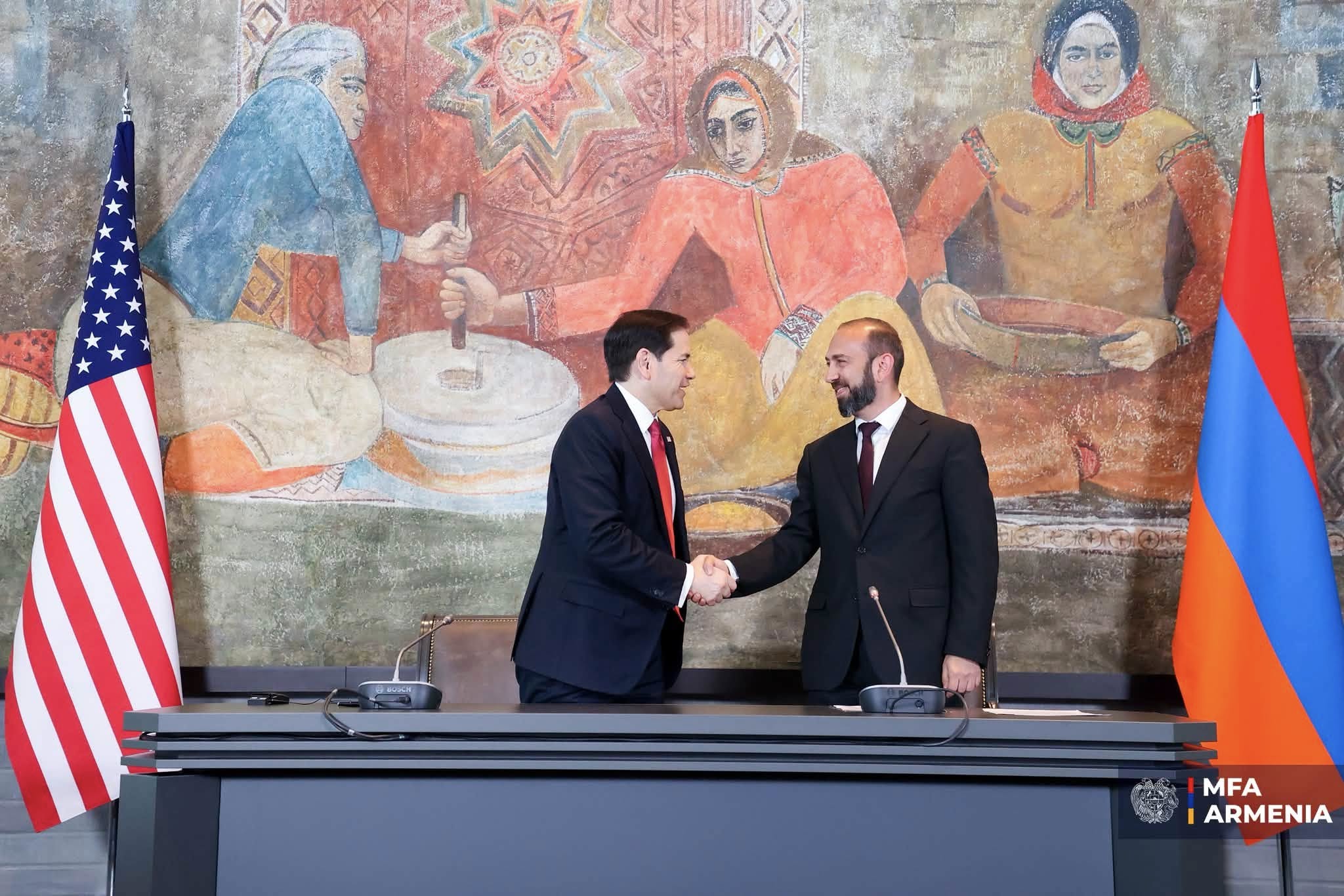
Against this background, the US is literally cementing its relations with Armenia, a country once considered the Kremlin’s outpost in the region. Shortly before the parliamentary elections in the country, Yerevan was visited by the United States’ top diplomat, Marco Rubio. Although the Secretary of State’s stopover at Yerevan’s Zvartnots Airport lasted only about an hour, it concluded with the adoption of a package of documents that effectively solidifies a new level of relations between Yerevan and Washington.
Marco Rubio and Armenian Foreign Minister Ararat Mirzoyan signed a charter on a comprehensive strategic partnership. In addition, documents were finalized on cooperation in the field of critical minerals and rare earth metals, as well as a framework agreement on the TRIPP project—the “Trump Route for International Peace and Prosperity.” It is this project that is being considered as a possible alternative to the global transit route through Georgia. The road, designed to connect Azerbaijan with its Nakhchivan exclave through Armenian territory, could become part of the region’s broader transport architecture.
The charter signed at the Yerevan airport broadly expands the agenda of cooperation with the US in the areas of security, technology, energy, and economy. The document specifically outlines areas ranging from artificial intelligence and space to nuclear energy and potential military-technical cooperation.
But for Yerevan, these agreements are also important as a diplomatic gesture. On June 7, elections will be held in Armenia, where the party of incumbent Prime Minister Nikol Pashinyan will be opposed by a number of opposition forces linked to Russia.
And in this context, Donald Trump’s public support for Pashinyan served as a distinct signal demonstrating US priorities in the region. The head of the White House published a special statement on the social network Truth Social, calling the Armenian Prime Minister a “great friend” and a leader who is making his country “strong, wealthy, and very secure.”
“Nikol fully shares my vision of PEACE and PROSPERITY for Armenia and the entire South Caucasus region. Our Secretary of State Marco Rubio recently visited Armenia, where he advanced several important agreements for both our countries. Soon, the United States and Armenia will together begin construction of the ‘Trump Route for International Peace and Prosperity,’ which will transform the South Caucasus and help our wonderful American energy companies gain access from Central Asia all the way to the United States.”
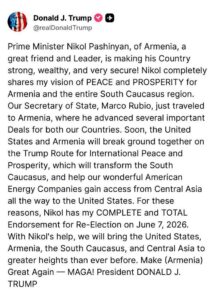 The US President further notes that Pashinyan receives his “COMPLETE AND TOTAL endorsement for re-election.” And he concludes the post with the words:
“With Nikol’s help, we will lift the United States, Armenia, the South Caucasus, and Central Asia to heights never seen before. Make (Armenia) Great Again—MAGA!”
Such a rapprochement between Yerevan and the West predictably draws Moscow’s displeasure. In mid-May, Russian President Vladimir Putin made a statement that many interpreted as a direct threat to Armenia.
Although the Kremlin leader initially said that Moscow “sees nothing special” in Yerevan’s plans to draw closer to the EU, he then urged Armenia to “make up its mind,” and to do so by holding a referendum. But most importantly, Putin chose to draw a parallel with Ukraine, recalling how everything started there: with Kyiv’s accession or attempted accession to the EU! “Therefore, there is no need to take things to extremes,” the Russian President said, returning to the subject of Armenia.
Against the backdrop of Rubio’s visit to Yerevan, Maria Zakharova, the official spokesperson for the Russian Ministry of Foreign Affairs (MFA), made a statement. According to her, Russia, “as before,” considers Armenia its “natural partner in the South Caucasus.” However, she warned that the course toward rapprochement with the West “erodes the mutually beneficial strategic partnership” between Russia and Armenia and “creates risks of Yerevan losing all the advantages derived from it.”
According to Zakharova, Armenia has received colossal bonuses from its cooperation with Russia.
“That is, there is no damage from interaction with Moscow in these areas—there is only profit and development, yet for some reason, they are starting to replace us on these tracks.”
The Russian MFA spokesperson also complained about the Pashinyan team’s “demonstrative connivance” with the “West’s targeted campaign to stimulate anti-Russian sentiment.” She stated that, “of course,” Moscow cannot help but be concerned by “the Armenian leadership’s course toward rapprochement with the North Atlantic community, whose main political line is geared precisely against Moscow”:
“So with whom is Yerevan concluding all these, well, quite strategic agreements on plans and intentions?” Zakharova questioned.
Meanwhile, as the elections draw closer, the Armenian leadership has begun to speak more and more openly about its plans and intentions without looking back at Russia. In early May, Yerevan turned into Europe’s main political center—two important events took place in the South Caucasian capital at once: a large-scale summit of the European Political Community, which brought together dozens of European leaders, including the President of France, the Prime Minister of the UK, and Ukrainian leader Volodymyr Zelenskyy, as well as the first-ever bilateral Armenia-EU summit.
Even earlier, in February, Yerevan was visited by the second person in the US political hierarchy—US Vice President JD Vance. At that time, he also supported Prime Minister Pashinyan’s candidacy in the upcoming elections. In parallel, several important agreements were reached, including on the supply of American V-Bat reconnaissance drones for the Armenian army—this is the first-ever American military equipment for Armenia, which formally remains an ally of Russia but holds the status of a strategic partner of the US and aims to join the European Union.
Against this background, Washington and Brussels’ relations with Tbilisi—once the regional leader of the Euro-Atlantic integration process—look particularly contrasting. Relations between the Georgian authorities and EU countries have reached a complete dead end; representatives of the ruling party increasingly refer to EU representatives as “Brussels bureaucrats.” In Tbilisi, the Trump administration is accused of being unable to cope with the influence of the “Deep State.” In parallel, a narrative is being promoted that Washington is beginning to realize the need for a reset.
Nevertheless, the rank of the virtually simultaneous visits of American delegations to Tbilisi and Yerevan speaks for itself. And on May 28, the day the United States’ top diplomat was signing strategic agreements in Armenia, he also published congratulations on the occasion of Georgia’s Independence Day. However, the addressee of the letter from Marco Rubio was not the country’s government, but the “Georgian people.”