
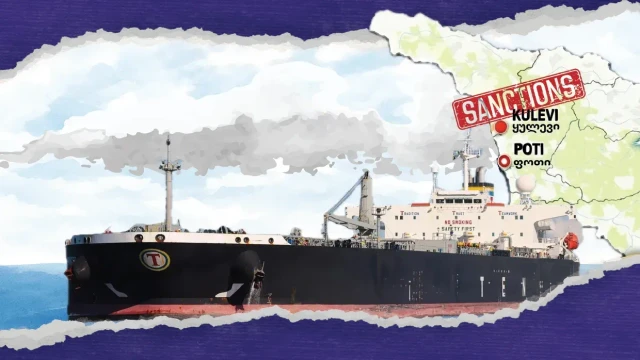

The investigative journalism association iFact has published an article titled “Who Delivered the Cargo from the Sanctioned Tanker to Kulevi?”. The authors report that five days ago they noticed a tanker arriving from Russia in the Black Sea, close to Georgian-controlled waters. They tracked its movements for several days, and on June 8, it entered the port of Kulevi.
In such cases, when a vessel waits so long to enter a port, there is an expectation that the competent authorities are verifying its history and the origin of its cargo. This is especially true given that the port of Kulevi and the ruling “Georgian Dream” party authorities previously promised their European partners that they would not accept suspicious cargo delivered by dubious vessels.
“We do not know what methods the Georgian side used to inspect this vessel. However, we can share how we verified it and what we discovered based on open-source data.
After a five-day wait, the tanker NEPHIRA, which entered the port of Kulevi yesterday, delivered about 30,000 tons of Russian petroleum products. It is not yet known who sent this cargo or who its recipient is. However, it is known that the NEPHIRA received this cargo through illegal means—via ship-to-ship transfer on the high seas, in Russian-controlled waters, from a vessel under strict international sanctions,” the article states.
According to official data, the tanker NEPHIRA’s entry into the port of Novorossiysk was not recorded. On May 29, it arrived near the port empty and soon disappeared from radar. As early as June 1, near the port, it received petroleum products from the tanker BOLTARIS. At that moment, the transponders of both vessels were mostly turned off, and the ships themselves used the same coordinate spoofing scheme: their signals showed movement over land and synchronous circular motion, the authors of the article claim.
After the transfer, on the evening of June 2 at 23:10, the NEPHIRA transmitted a signal again from a Russian-controlled area, after which it disappeared from radar once more. The next signal was detected off the coast of Abkhazia, opposite Sukhumi, at around 6 a.m. At the same time, the vessel officially indicated that it was sailing without cargo. On June 3, the tanker entered Georgian-controlled waters and, on the same day, changed its draft reading from 8.5 to 13.2 meters, indicating the presence of cargo on board.
The tanker BOLTARIS (IMO: 9251456) has been under sanctions by the European Union, the United Kingdom, Canada, Ukraine, Switzerland, and Australia since the spring of 2025. During its operation, the vessel has changed its name six times and its flag ten times.
The owner and commercial operator of the BOLTARIS is TRIDENT SERENITY LTD, a company registered in the Seychelles. The vessel’s safety management is carried out by MARITIME MAVEN MANAGEMENT LTD, registered in the United Arab Emirates (Dubai). Information regarding the vessel’s insurance is absent from official databases.
Ukraine drew attention to the suspicious activities of the BOLTARIS as early as 2023. At that time, the vessel transported 30,000 tons of diesel fuel belonging to Rosneft from the Russian port of Tuapse to the UAE. Tuapse is home to an oil refinery and a marine terminal owned by the sanctioned PJSC Rosneft Oil Company.
BOLTARIS has also repeatedly participated in ship-to-ship oil transfer operations. In particular, in September 2024, it transferred cargo to the tankers OSTRIA and SKIRON.
According to VesselFinder and Equasis data, the NEPHIRA was built in 2009 and currently sails under the Panama flag. The vessel’s owner and management companies are the Greek-based ELLI SHIPTRADE LTD and STAR MARINE MANAGEMENT INC. Since April 2026, the tanker has been insured by the Norwegian company Assuranceforeningen Gard. Until July 2025, the vessel was named ISE PRINCESS and sailed under the Liberian flag. Information about the owners of the companies associated with the NEPHIRA is unavailable, and no suspicious information about them could be found in open sources.
“We also reached out to the Maritime Transport Agency of Georgia regarding this matter. We were told over the phone that questions should be submitted in writing. We sent an email inquiry and gave the agency one hour to respond. At this moment, no response has been received. If the agency provides a comment, the article will be updated,” the piece concludes.