

The Georgian Young Lawyers’ Association (GYLA) has lodged an application with the European Court of Human Rights regarding the coordinated and politically motivated persecution, vandalism, intimidation, and stigmatization directed against the organization.
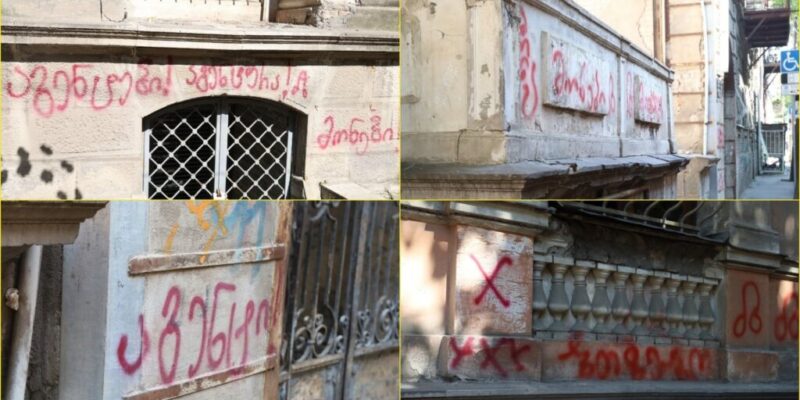
On May 9 and 31, 2024, amid the passage of the “foreign agents” law (the so-called “Russian law”), the facade of the organization’s central office—an immovable cultural heritage site—was defaced with graffiti, including “Agents,” “Network of Agents,” “Traitor,” “Traitors,” and “Enemy of the Nation,” alongside posters bearing similar messages. Following the act of vandalism on May 31, 2024, Dimitri Samkharadze, a Member of Parliament from the ruling Georgian Dream party, insulted civil society representatives and opposition figures on Facebook, issuing direct threats. Furthermore, Samkharadze attached a video montage displaying attacks and vandalism against the offices of several non-governmental organizations and opposition forces.
The Association emphasized that it handed over detailed information and physical evidence to investigative bodies on the very days of the attacks, demanding an appropriate legal response. For two years, the organization urged the Special Investigation Service, the General Prosecutor’s Office, and the Ministry of Internal Affairs to conduct an effective investigation into the attacks on its office under the following articles of the Criminal Code of Georgia: Article 156 (persecution), Article 187 (Part 2, Item “c” — damage or destruction of property committed by a group), and Article 259² (Part 1 — damage or destruction of a cultural heritage site), but to no avail.
The organization first learned that any investigation into these events was being conducted at all through the Office of the Public Defender (Ombudsman). In response, the young lawyers challenged the investigative authorities’ inaction and petitioned to be granted victim status in the proceedings. However, no reply was received from the General Prosecutor’s Office, and the Tbilisi City Court subsequently rejected the organization’s motion. Notably, it was only through the ruling of the Tbilisi City Court that the organization learned the investigation was being pursued solely under the least severe classification: “threat” (Article 151, Part 1 of the Criminal Code of Georgia, which carries a maximum penalty of up to one year of imprisonment). At the same time, the statutory two-year limitation period for three of the four aforementioned articles (Article 156, Part 1; Article 259², Part 1; and Article 151, Part 1) had already expired. Consequently, holding the perpetrators criminally liable under these provisions is no longer possible.
Because the building housing the GYLA office holds the status of a cultural heritage site, the organization is legally prohibited from independently cleaning the facade and removing the graffiti. The authority to remedy such damage belongs exclusively to Tbilisi City Hall. In light of this, the lawyers applied to the municipal administration five times, demanding that it address the incidents within the legal framework by erasing the graffiti or granting the organization formal permission to clean the facade itself.
According to the organization, it took nearly two years to receive an initial response from LLC Tbilservice Group (a municipal enterprise wholly owned by Tbilisi City Hall). The company stated that it could not remove the graffiti because the building was old and the required equipment could cause further damage to the walls. In this instance as well, the lawyers obtained this information solely through communications via the Ombudsman: it emerged that Tbilisi City Hall had initiated proceedings regarding the attacks only on the basis of Article 150², Part 5 of the Code of Administrative Offences (“defacing the visual appearance of the municipality of the City of Tbilisi”). Crucially, the limitation period for imposing administrative liability under this provision had also expired, as it is restricted to three months.
“In view of the state’s breach of the aforementioned positive obligations under the Convention, GYLA is challenging before the Strasbourg Court the violation of the following rights enshrined in the European Convention on Human Rights: the protection of property (Article 1 of Protocol No. 1 to the Convention), freedom of assembly and association (Article 11 of the Convention), and the prohibition of discrimination (Article 14 of the Convention, taken in conjunction with Article 1 of Protocol No. 1 and Article 11 of the Convention).
In the application, the Association points out that leaving hostile and offensive graffiti on the office facade, the authorities’ inaction, and the explicit public endorsement of these actions by a representative of the ruling party violate freedom of association. The applicants maintain that these actions were intended to intimidate GYLA’s staff, supporters, and beneficiaries, paralyze the organization’s work, and undermine public trust in it.
Furthermore, the application places special emphasis on the issue of selective justice. While the investigation into the ransacking of GYLA’s office and the harassment campaign dragged on fruitlessly for two years until the statutes of limitations expired under three of the four relevant articles, the state apparatus reacted with unprecedented speed and severity when activists targeted ruling party posters. For instance, criminal proceedings under Article 187 of the Criminal Code were opened immediately against activist Megi Diasamidze and politician Elene Khoshtaria over protest slogans painted on the Tbilisi mayor’s campaign banners, with Khoshtaria sentenced to one year and six months of imprisonment. These facts clearly demonstrate that the state’s response is politically biased and discriminatory, directly contravening the European Convention on Human Rights,” the human rights organization stated.
GYLA emphasized that its application to the European Court is intended to defend its institutional rights, as “a harassment campaign against a human rights organization, conducted with the connivance and support of state institutions, undermines the fundamental protection of the rights and freedoms of all citizens of the country.”