
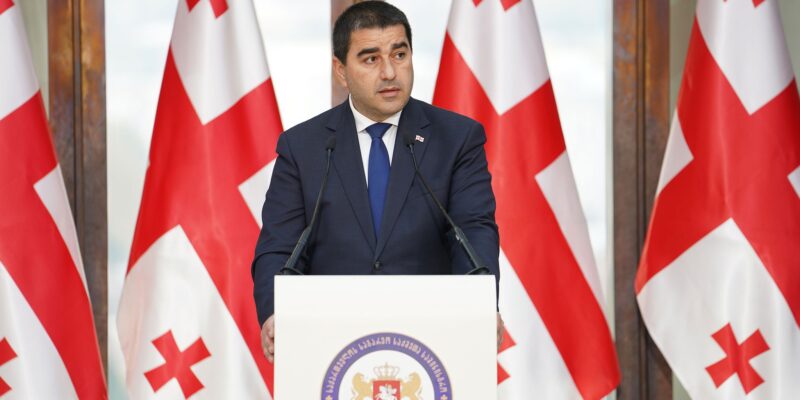

“A year has passed since October 4, 2025 — one year later, I once again call on Brussels to condemn the October 4, 2025 violent assault on the presidential palace, to renounce future political and financial support for radical groups, and to repeal resolutions that infringe upon Georgia’s sovereignty,” Chairman of the Parliament Shalva Papuashvili wrote on social media.
According to him, “one year after the failed coup, it is particularly obvious: on October 4, not only did a specific violent plan collapse, but also the notion cultivated for years that power in Georgia could be changed not through elections, but via street violence and foreign political support.”
“Today marks one year since October 4, 2025 — the day an attempt at a violent change of power in Georgia culminated in the storming of the presidential palace.
One year later, court verdicts have been handed down, and the organizers and participants in the storming are serving their sentences. A significant portion of those convicted have admitted their guilt.
One year is sufficient time to look at the events of that day not through the prism of emotion, but through the complete chain of facts.
October 4 did not begin in a single day.
It was preceded by weeks of open announcements of the overthrow of power, the romanticization of violent scenarios, and the political incitement of radical groups.
Against this backdrop, a few days before October 4, a European Commission spokesperson was asked a direct question about the announced demonstration, and in response we heard neither a call to participate in the elections nor a warning against violence, but an outright expression of support for an announced rally aimed at a coup (!).
At the time, we publicly stated that this was an extremely irresponsible statement: when the overthrow of power is announced in advance, such a political signal is perceived by radicals as encouragement.
Unfortunately, a few days later, exactly what we had warned about occurred.
On October 4, rally participants marched toward the presidential residence and attempted to storm the palace. The country, which had been doomed to bloodshed from abroad, was saved from a return to the 1990s solely by the precise and coordinated actions of our law enforcement agencies.
Here, it is especially important to recall another circumstance.
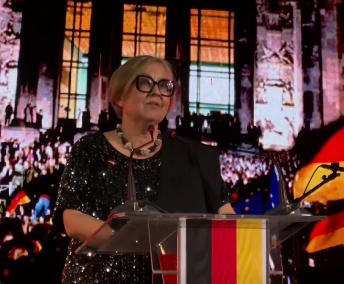
Prior to this, for months, former President Salome Zourabichvili had positioned herself as an alternative center of legitimacy. To reinforce this narrative, foreign politicians and diplomats regularly visited her for ‘consultations’, posing beside her against the backdrop of the presidential standard.
Even then, we warned: toying with state symbols and creating the illusion of a non-existent dual power is by no means harmless political theater. Such symbolism can provoke people into real action.
That is why on October 4 the presidential palace became a target by no means accidentally. Nor is it accidental that following the failure, we have not seen a single ‘meeting’ between Zourabichvili and diplomats. Yet to this day, we have heard no condemnation from Brussels of the assault on the presidential palace, nor any clear distancing from the perpetrators of violence.
One year after the abortive coup, it is particularly clear that on October 4 not just a specific violent scenario was defeated — the illusion cultivated for years that power in Georgia could be changed through street violence and external political backing instead of elections has finally collapsed.
Such is the main lesson of October 4: the fate of Georgia is decided by the Georgian people — through elections, not through storming.
And in conclusion, one year later, I once again call on Brussels:
to condemn the violent assault on the presidential residence on October 4, 2025,
to renounce further political and financial support for radical groups,
and to annul resolutions impinging on Georgia’s sovereignty,” Papuashvili writes.
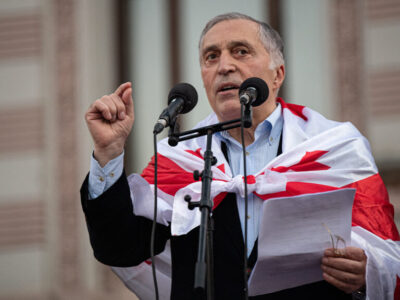
As a reminder, on October 4, 2025, concurrent with Georgia’s municipal elections, a massive protest took place in central Tbilisi, which the opposition termed the “National Assembly.” One of the rally’s organizers, the world-renowned opera singer Paata Burchuladze, read a declaration from the stage announcing the termination of the government’s mandate and the commencement of a peaceful transition period. He also called for the detention of Prime Minister Irakli Kobakhidze, ruling party founder Bidzina Ivanishvili, and other leaders of Georgian Dream.
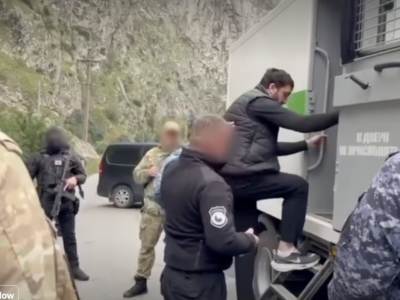
Shortly thereafter, a segment of the opposition and its supporters marched toward the presidential residence, where protesters tore down the fence and attempted to breach the Orbeliani Palace. The rally was dispersed by riot police, and many of its organizers were detained and sentenced to prison terms.