

This material is part of a partnership with OC Media. You can read the original English version here.
The Russian-language regional branch of Radio Free Europe/Radio Liberty (RFE/RL) — Ekho Kavkaza — has ceased operations. This move comes amid financial difficulties faced by the organization under the U.S. administration of President Donald Trump, as well as broader structural changes affecting several of the organization’s bureaus.
Ekho Kavkaza has not yet officially addressed its audience with a farewell message; however, information regarding the suspension of its activities as of May 1 was included in a press release published by RFE/RL on April 28 regarding “strategic reforms.”
According to an informed source within the organization, staff in both the Tbilisi office and the Prague headquarters have already been dismissed. The source also noted that contract employees received severance payments.
Demis Poladov, editor-in-chief of Ekho Kavkaza, wrote on social media on April 30 that it was his “last working day at Radio Liberty.” He was unavailable for comment at the time of publication.
Founded in 2009, Ekho Kavkaza was a media project aimed at covering “events in Georgia and the self-proclaimed republics of Abkhazia and South Ossetia in Russian.”
Like RFE/RL as a whole, the project faced hostility and restrictive measures from the Russian authorities.
Moscow first declared RFE/RL a “foreign agent” (inostranny agent) in 2017, and in February 2024, it went further, designating it — along with all its subdivisions, including Ekho Kavkaza — as an “undesirable organization” (nezhelatelnaya organizatsiya).
Under Russia’s draconian legislation, the latter designation is more severe, exposing not only the media outlet’s employees but also its donors and even interviewees to the risk of criminal prosecution.
Shortly thereafter, in March 2024, Ekho Kavkaza announced the suspension of its radio broadcasts, noting that the anticipated difficulties associated with its recognition as an undesirable organization left it with no other choice.
“We cannot risk losing our correspondents and experts who hold Russian citizenship during live broadcasts. The lack of live airtime and the inability to record interviews with politicians, experts, and ordinary residents of Abkhazia and South Ossetia make the radio format unfeasible at this time,” the statement said.
However, the project’s website and social media pages continue to operate to this day. Following the closure, Ekho Kavkaza will likely remain accessible online but will no longer be updated.
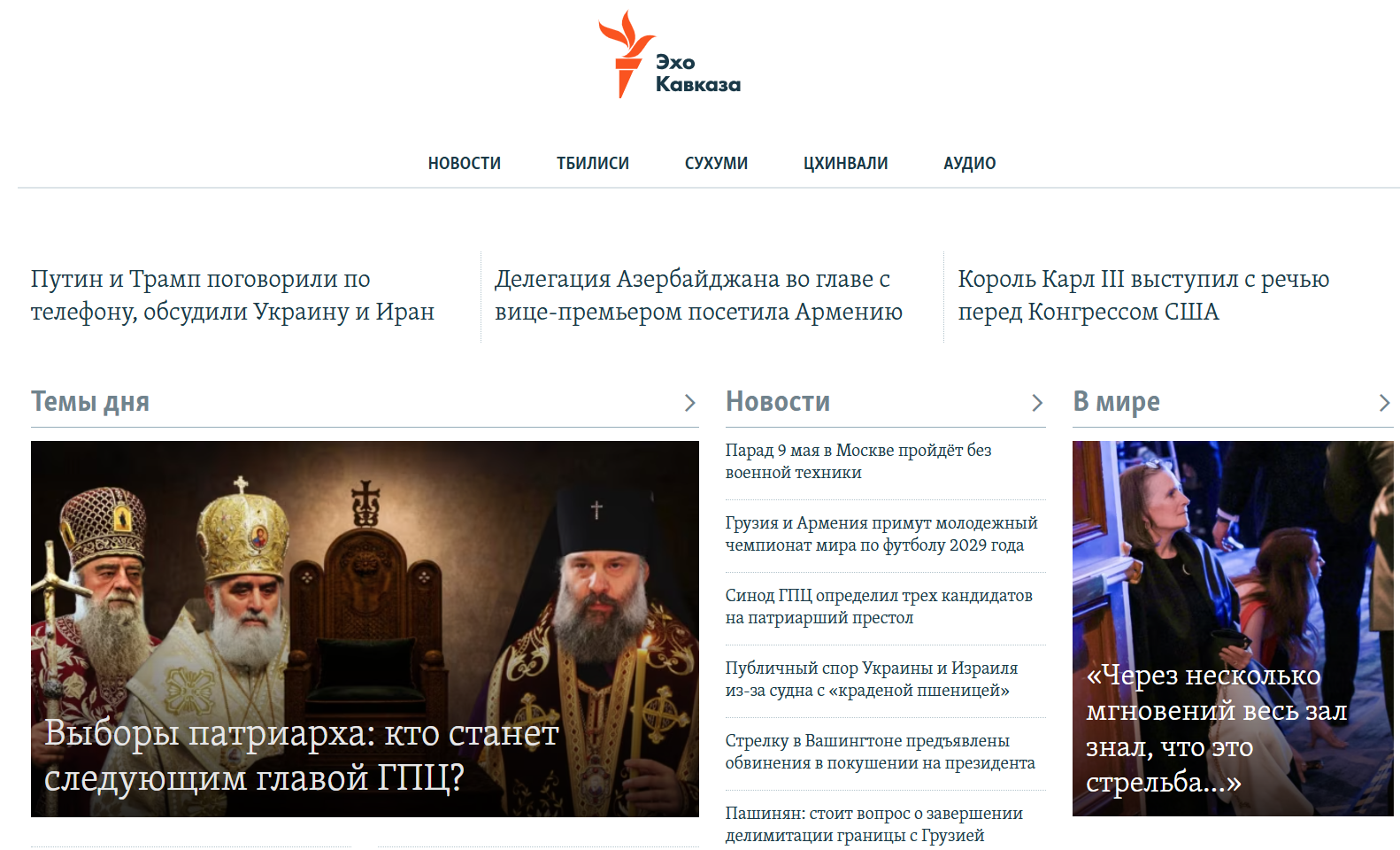
The Ekho Kavkaza website. At the time of publication of the OC Media material on SOVA — March 3 — the latest publications were dated April 30.
Alongside the closure of Ekho Kavkaza, RFE/RL management also announced the consolidation of several other services — the Russian Service (Radio Svoboda), Current Time, the Tatar-Bashkir Service (Radio Azatliq), and the North Caucasus Service (Radio Marsho) — into a single multimedia programming unit for audiences in Russia.
“All four service brands will remain in use, reflecting the loyal audience they have built over many years,” the press release stated.
The Trump Administration and Financial Issues
Founded in 1949, Radio Free Europe/Radio Liberty (RFE/RL) is funded by the U.S. Congress through a federal grant provided by the U.S. Agency for Global Media (USAGM).
Along with Voice of America (VOA), the outlet is often credited with disseminating information and news to countries behind the “Iron Curtain” during the Cold War.
RFE/RL has several branches in the Caucasus, publishing news and analysis in Russian, Georgian, Azerbaijani, Armenian, and Chechen, and is considered one of the leading independent and non-partisan media outlets in the region.
Speaking about the reasons for the closure of Ekho Kavkaza, the source noted that it was related to how the Trump administration managed RFE/RL’s funding through USAGM — first suspending it and then resuming it, but at a reduced level.
In March 2025, shortly after taking office, as part of “reducing federal bureaucracy,” the administration took steps to sharply reduce the activities of USAGM and its supported agencies, including RFE/RL. Shortly thereafter, RFE/RL CEO Stephen Allan “Steve” Capus stated that the media company’s grant agreement had been terminated.
RFE/RL challenged this decision in court, arguing that the executive branch does not have the right to withhold funds already allocated by Congress. U.S. courts largely agreed, issuing rulings that blocked the funding cuts and later ordered the government to release at least a portion of the funds.
Financial uncertainty amid legal battles throughout 2025 put the company under significant pressure.
Although funding for USAGM and its associated media was ultimately included in the 2026 fiscal year budget signed by Trump, the amounts were lower than in previous years: according to Reporters Without Borders (RSF), the budget was cut by approximately 25% compared to previous years.
Funds allocated by Congress for RFE/RL itself in the 2026 fiscal year amount to $112.5 million.
“These measures are being taken to maintain RFE/RL’s position as an influential, relevant, and financially responsible organization,” Capus was quoted as saying in the press release published on Tuesday.
“We are strengthening our commitment to result-oriented journalism — specifically, investigative and analytical journalism. During the restructuring, we are saying goodbye to some truly talented colleagues who have long been dedicated to RFE/RL’s mission,” he added.
Shortly before the latest announcements, in late March, RFE/RL closed its Bulgarian, Romanian, and North Macedonian services, as well as Radio Mashaal — its Pashto-language service for Pakistan’s tribal regions.